Wednesday, February 29, 2012

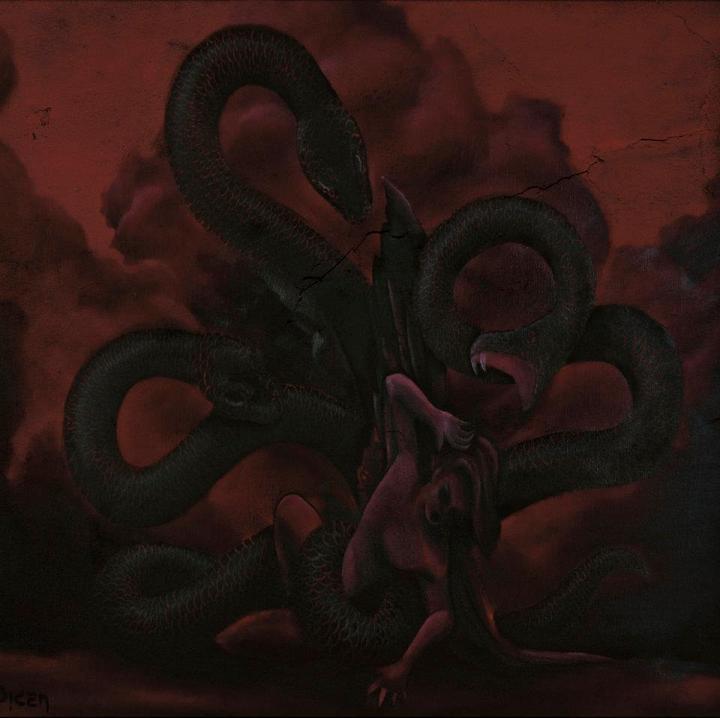
Black Hole of Calcutta - "Black Hole of Calcutta" (2012) [Give Praise Records]

Fittingly named after the infamous dungeon-esque hellhole that consumed British prisoners of war, Black Hole of Calcutta is an excellent slice of blackened-y grind that should be surely checked out.

Upon hitting the play button for the first track, “Myth of Progress,” and hearing the subsequent sludgy, doom and feedback laden riffs, amongst slow pounding drums, I thought to myself, well, here’s to what is hopefully another good offering of doom/sludge that has popped up yet again – but about a minute after that thought, I was thrown into a vortex of grinding riffs, raging vocals, and a whole load of, uh, awesome, only slowing down towards the during the outro.

After listening to the first track, and viewing the following track’s song times (ranging 37 seconds to a little over 2 minutes, asides from the longer, 5 minute first track), I knew I was in for something I wasn’t expecting at all with my initial impression.

15 minutes later (the album runs 20 minutes in total, with the inclusion of track 1), I had been through a torrential burst of speeding riffs, energetic blastbeats, and black metal-esque, hate filled vocals, with some songs erring more grind like, and some more hardcore like, but all completely relentless in their execution.

Blackened crust/grind/powerviolence is something that doesn’t really pop up often, which is unfortunate because, as one of my favorite grind bands ever (Watchmaker) has proven, and as Black Hole of Calcutta is now showing, it’s damn good stuff, and I’m looking forward to more of it.

Give the album a listen here: http://bhoc.bandcamp.com/

- Chase

Tuesday, February 28, 2012

A Death Cinematic - "The New World" (2012) [Simple Box Construction]

The New World is here.


A mere few months after his split release with Demian Johnston's Great Falls, the mysterious entity known as A Death Cinematic has built The New World, his first full-length since 2009's A Parable on the Aporia..., brick by brick. Once again we see an incredible amount of work and love put into this new Simple Box Construction release, the disc itself housed in a handsome, stamped cardboard sleeve, accompanied with a handmade artbook companion, both fit comfortably in a gorgeous balsa wood box. To be completely honest, even if I didn't like the music presented here, I would still urge you all to buy one of these for the artwork and packaging alone. This is a labor of love, with countless hours going into the perfection of the final product.

Luckily for us, the listeners, A Death Cinematic takes another giant step forward with The New World, presenting the world with the project's strongest, most memorable release. Acting as the soundtrack to a McCarthy-esque, post-apocalyptic world, A Death Cinematic's Morricone-inspired guitar drones echo clouded sunsets over abandoned cities and uninviting deserts. Unlike fellow "Americana drone" artists Earth and Barn Owl, who are both great in their own right, A Death Cinematic's music truly embodies the bleak passages of which fuel this micro-scene's life. The shifting abstraction found within the slightly off-kilter guitar layers, often slightly out of time with each other, may prove to be off-putting at first, yet the overall harmonious nature of sole member K.'s centrally focused, improvised music more than makes up for it. Poet and spoken word artist Matt Finney makes a memorable appearance on The New World's final, self-titled track, dragging the already morose and desolate atmosphere built throughout the album into the deepest pits of despair. Finney's slow, creaking Southern drawl acts as the perfect complement to the deep, Hank Williams-inspired slide guitar included on this concluding track, which ultimately deconstructs into pure cacophony.

The New World has arrived, and it sounds like the end. Clocking in at just over fifty minutes in length, The New World shows A Death Cinematic fully embracing his apocalyptic leanings; wandering like blown tumbleweed and creaking like abandoned record players. Limited to a scant 150 copies, The New World might just pass you by if you don't act fast enough. Purchase your copy straight from the source.

-Jon

Icon of Phobos - "Icon of Phobos" (2011) [Baneful Genesis Records]

Los Angeles is no stranger to a good metal scene – partly due to the fact that most of the great tours in the US tend to stop by, and also that there are just some damn good bands there as well. Conversely, there are also a lot of run of the mill, or just plain, shitty bands (I think some of the worst locals I have ever heard were in LA). Having to wait through local openers at an LA show can really, really vary, in just about any genre, for that matter. Los Angeles is, without a doubt, saturated with generic black metal as well, but there are bands who manage to break through this, both with their releases, and with their live performances.

So, say hello to Icon of Phobos, who released their self titled album in mid November of last year. The band features a variety of musicians who have been invested in the scene for quite some time, including some bands who have had some great releases -  Pendulous (previously Dona Eis Requiem), Spiculum Iratus,  and Bestial Incarnation.

Following some hellish gurgle sounding as if from the maw of satan,  the opening track breaks into a mid paced black metal assault, accompanied by thunderous drums, and some damn excellent vocals as well – very reminiscent of Funeral Mist, both in terms of Arioch’s style, and as well as the music as a whole.
Production wise, the music has a good balance, not going for anything too raw, yet not for anything overly polished, and a good mix of all pieces of the music are present in the album.

While Icon of Phobos doesn’t really bring anything new to the table, they play an orthodox style of black metal that is good in doses, and if you can find a live video of them, great in a live setting. If I were to listen to this album without any knowledge of the band, I wouldn’t be surprised at all if they were from Sweden or Finland – in fact, I’d be more surprised at learning that not only are they from here in the US, but from Los Angeles.

If you want a dose of orthodox black metal, check this out, and if you find yourself in sunny southern California, make sure to see if they’re playing live for one hell of a crushing performance.

-Chase

Wednesday, February 22, 2012

Vaura - "Selenelion" (2012) [Wierd Records]

Elegance isn't a quality one would normally associate with metal. A genre with roots in spandex and weapons-grade hairspray, "heavy metal" has proven itself as more of a source of fear for parents rather than a haven for the artistically inclined. Elegance, as defined by the Oxford Dictionary of the English Language, is "the quality of being graceful and stylish in appearance or manner." Of course, as a person who actually enjoys music for its ability to hold my interest rather than artistic merit, "elegance" isn't a deciding factor in whether or not a band is good, though its place in metal is a worthwhile topic in our modern age. Yeah, yeah, there are bands like Opeth and Alcest whose "heightened harmonic awareness" have brought about "art metal"'s undeniable peak. However, in my opinion, neither Opeth's hellbent-for-vintage sound nor Alcest's childlike nostalgia truly exudes what I feel is elegance. Though some bands and releases demonstrate qualities of elegance, the inherent maturity and grace found within Vaura's debut album, Selenelion, acts as a doorway through which elegance, in my opinion, at the very least, has found its way into metal's swarth.*

Selenelion is one of those albums which proves itself to be exceedingly difficult to place on the "genre scale." An artistic union between the minds who brought you Kayo Dot, maudlin of the Well, Dysrhythmia, Gorguts, Religion to Damn, and lots more, Vaura's intelligent, flowing, unique approach to metal utilizes a myriad of styles as vast as the visible light spectrum, which is proudly displayed on the album cover. Based around a core of shimmering, atmospheric metal, Vaura fearlessly incorporates elements of expansive post-rock, forward-thinking black metal, 70s psychedelia, and even post-punk, resulting in a far-reaching, fresh-sounding fusion which could please Mono and Cynic fans alike. Frontman Joshua Strawn's haunting, pure voice is the perfect companion to Vaura's eerie-yet-chiming music and esoteric subject matter, ranging from the "Drachma" coin, which was used in Greek mythos to raise the dead, to a few Jorge Luis Borges references.

A selenelion occurs when both the sun and moon appear as one entity just after a full lunar eclipse. The best way to describe the phenomenon is if someone lit exactly half the moon on fire and hung it low in the sky, which is the absolute perfect visual representation of Vaura's sound. Rooted in sonic equality between light and dark, Selenelion pits Joshua Strawn and Kevin Hufnagel's chiming, at times almost cheerful guitar work against rhythm section Charlie Schmid's cataclysmic drumming and Toby Driver's deep, dark bass, all while Strawn croons and howls like a possessed Kristoffer "Garm" Rygg somewhere in space. One can only witness a selenelion a few times a year at best, but one can experience the selenelion's astral juxtaposition through this elegant record.

Vaura's Selenelion is currently available for preorder from synthwave/post-punk label Wierd Records and will be officially available on CD and super luxurious 2LP on February 28th. Order this one, you won't regret it.

-Jon

*Yeah, I said "elegance" in some shape or form six times in the intro, but using synonyms would have made it confusing. Deal with it.

Sunday, February 19, 2012

Owlscry - Owlscry (2012) [Self-Mutilation Services]

Owlscry has been around for a few years, but this is their first full-length release. I have no idea why they've been sitting on the recordings for over a year, but it's good to see them finally available.

Owlscry have some affinity for their neighbors in Wormsblood. While producing something distinctly recognizable as black metal, they don't embrace all of the standard sounds as necessary techniques. The most obvious is the heavy inclusion of "clean vocals," or as the rest of the universe calls it, "singing." Owlscry aren't afraid to build on timbre-and-rhythm-centered minimalism or use clean guitars and musical chord progressions. Owlscry certainly don't go for the continuous blasting and trem-picking of many of their counterparts, but instead frequently achieves a sort of rocking vibe somewhat reminiscent of Lifelover.

In fact, Owlscry resemble nothing quite as much as a blacker, heavier Lifelover with a more large-scale concept of songwriting. Like perhaps a meeting of Lifelover, Bethlehem, and the lengthier works of fellow Americans (Nightbringer, Sutekh Hexen, Weakling).

I don't think I've ever dropped so many names in a review. Don't for a second think that it's because Owlscry sounds like anyone else. If you want to hear creative black metal with no Satan, Hitler, suicide, or flowering trees, look no further. Owlscry continually explore new and relevant musical approaches without incoherence or gimmick.

Now where's the Owlscry merch?

-V.

Goliathon - Without Further Ado (2010) [Self-Released?]

I . . . this is like they listen to classic rock radio all the time, but really like Porcupine Tree and some stoner rock. I'm sure that's not as weird or unusual as I think it is, but my god if they haven't hacked out their own niche (possibly by beating one into existence with a saxophone). In literally every song, I'm reminded of mainstream-groupie-70's and 80's hard rock (Guns 'n' Roses, Led Zeppelin, Sabbath), the rattle and atmosphere of The Jesus Lizard noise rock, and the heavy-rock-prog-modern off-kilter riffing of Porcupine Tree. And Mastodon/High on Fire.

I know I don't normally namedrop like this, but it really sounds like all of those things at once. I've always hated the self-assured, soulless hard rock sneer that their singer wails, but with all of the music Goliathon brings together and with the intricacy of their songs (no "Riff A 4x, I IV V" here), I kind of have to keep listening. I have to. Because if I stop, I'll miss something insane they did.

What.

Thursday, February 16, 2012

Cornfields and Black Lace: The Midwest Post-Punk Resurgence

When one thinks about the Midwest, only two things come to mind: Chicago...and endless cornfields, because apparently that's all that happens to be out here. If that isn't bad enough, the general consensus about music out here runs the gamut from Nachtmystium to Slipknot. Yes sir, we Midwesterners sure have an outstanding reputation. Deep beneath the wallet chains, Tripp pants, and drug addictions, something much more glorious (and legitimately downtrodden) in seedy late bars and warehouses throughout our fair land. Call it post-punk, peacepunk, goth rock, or one of its many other names, it is impossible to deny the presence of such new greats as Cemetery, Anatomy of Habit, Population, and Kam Kama (more on the last two later), among many others, in this burgeoning Midwest scene.

In post-punk's early '80s heyday, the Midwest United States proved to be one of the most reserved regions in the country. With the no wave scene to the East, deathrock to the West, and darkwave's earliest beginnings with San Antonio's Lung Overcoat to the South, Middle America found itself in the position of the middle child: appreciated, but only in passing. Though success found itself by way of notable Lincoln, Nebraska act For Against, the first to blur the line between post-punk and "dreampop," many groups like Chicago's short-lived DA! ended up swept under the proverbial rug.

After years of relative silence (For Against still regularly put out albums in the '90s, but it was never the same), the late 2000s showed the Midwest's love affair with gloomy, 80s-inspired music in full swing, bringing about the beginnings of most of the aforementioned bands. After a celebrated demo cassette release in 2010, Chicago post-punk quartet Population joined the likes of legendary shoegazers Astrobrite as part of the BLVD Records family, home to some of Chicago's finest esoteric pop. The Population 7", BLVD's fourth release, is a shining example of powerful, true-to-style revivalism. Armed with hook-laden basslines, the most Curtis-ian of baritones, and instantly memorable choruses, Population tranports whatever room in which your record player resides back in time to late 1970s Manchester. Ranging from Bauhausian romp to Joy Division gloom, any "closet goth" with common sense will listen to this 9 minute, three song 7" over and over again. You won't find any major label phonies here; Population are the real deal.

Operating on the opposite side of the spectrum is Bloomington, Indiana's Kam Kama. With an internet-only demo and a "digital 7"" under their belt, Kam Kama made their entrance to the realm of physical releases with Sister Cylinder Records's gorgeous The Tiled House 12". Utilizing a similar, dreamy style to For Against, Kam Kama's scope strays from post-punk's usual "doom and gloom" outlook for something much more...nostalgic, which is exceptionally fitting for Middle America. I don't know if many of you have ventured outside the Chicago area, but most of the Midwest hasn't been able to keep up with its concentrated metropolitan areas, leaving most places somewhere in the mid-to-late 1980s, complete with bright, albeit fading, neon clothing, boom boxes, and headbands. Sounds straight out of a John Hughes movie? Well...it kind of is, and Kam Kama's The Tiled House carries that sort of happy, albeit faded feeling which accompanies those sorts of memories. The Tiled House's ethereal, subdued guitars and nasally, endearing vocals (courtesy of bassist and Fosdyk Well member Scott Ferguson) echo the sort of nostalgia one feels when flipping through their high school yearbook's yellowed pages or watching a dusted VHS of home movies. It's a happy sort of sensation, but with a longing for times past.

Though we're about thirty years too late, it looks like the Midwestern United States finally has a fighting chance in the battle against happiness. "Post-punk revival" has been a semi-"big deal" in some circles, with some newer acts like Editors, O. Children, and Interpol receiving critical acclaim, though, thanks to the hard work of the aforementioned acts, along with labels like BLVD and Wierd Records, among many others, the music of the 80s goth will always be a staple of the underground. At the rate bands are popping up in my home region, 30 years might turn Chicago into a Manchester-like punk angst Mecca.

I can dream, right?

-Jon
Tuesday, February 14, 2012

Servile Sect - "SVRRENDER" (2012) [Handmade Birds]

Outer space is fucking frightening. I know, it's weird, but hear me out. Most people romanticize and even find comfort in Carl Sagan's "pale blue dot" speech, but, for some odd reason, the concept of extreme nothingness is absolutely horrifying. It seems sort of silly, but when looking into the night sky, there is infinite horror in attempting to comprehend that the stars which appear millimeters apart are actually billions of lightyears from each other (and, chances are, they've also gone out by now, as well). Aside from some cosmic dust, the vast expanse of space's overlapping endlessness is almost Lovecraftian in nature; impossible to describe and as maddening as it is empty.

Released companion piece to their previous album, the critically acclaimed TRVTH, Servile Sect's SVRRENDER seems to double as a complement to its predecessor, both in performance and atmosphere. As awesome as TRVTH is (I still feel stupid for not including it in my "Best of 2011" list), it does sort of take on the "romantic deep space" character which seems to confuse me. The pensive, melodic black metal and lush, alien synthesizers found on TRVTH, however perfect and grandiose, didn't really fit into my fear-shaped definition of space. Though the atmosphere of TRVTH does not negate the album's brilliance, the agoraphobic, hellish sounds presented on SVRRENDER definitely cater more to my "there is infinite nothing out there and it is horrifying" view of outer space. Much like TRVTH, SVRRENDER's two sides are completely different entities, one more caustic and traditionally bent, and its opposite an experiment in sound, seeing how far they can stretch the definition of "black metal." Unlike TRVTH, however, this album starts off with a metallic punch. After a short introduction of theremin sounds and rumbling synthesizer, the ambiance seemingly explodes into thick, terrifying, orthodox black metal, only to subside into ambiance once again. Side A speeds forward through expansive drones and black metal supernovae, searing the listener's ears like moon dust (apparently moon dust was so caustic NASA was afraid it would eat through Neil Armstrong's space suit). Though the metal presented on this first side isn't as...adventurous as Servile Sect's previous outputs, the almost atonal approach, coupled with inhuman feedback and strange interludes, almost perfectly outlines the sort of fear I feel when trying to comprehend the infinite, albeit compressed so as to bring the stars closer together.

Side B, on the other hand, is an absolute monster. I never really expected Servile Sect to throw their collective hat into the drone/doom metal ring, yet they pull it off flawlessly. Like a lo-fi cousin of like-minded experimental masters Locrian, the three tracks on side B lurch forward at the rate of Neptune's solar orbit, stacking layers of field recordings, synthesizers, and treated vocals over a steady base of plodding drums and steady bass. As unexpected as it is incredible, Servile Sect's take on drone/doom has been one of the coolest surprises of the past year.

The nightmarish sounds of SVRRENDER will come as a surprise to recent Servile Sect fans, but for the few who longed for an album to rival Stratospheric Passenger, it is time to get excited. A much more "orthodox" (I use that term loosely) companion to its predecessor, SVRRENDER's frightening depiction of deep space and madness is the perfect companion to your favorite 1950s "They Came From MARS" film (or for the extremely stupid weather we've had here in the Midwest). Out of the 250 copies made, I believe there are only a handful left, so be sure to grab one for yourself from Handmade Birds Records before they're gone for good.

-Jon

Sunday, February 12, 2012

Eolomea - "Eolomea" (2012) [Brave Mysteries]


Eolomea is a demonstration of the best of the non-noise artists grouped in the noise scene. Like Locrian, it's Andre Foisy playing guitar (in a way not remotely resembling any of that silly "riff" and "solo" garbage) and someone else--this time, the legendary David Reed of Envenomist--building sound with synthesizers.

Reed is not, however, Terence, and Eolomea is hardly likely to be confused with Locrian. While centered on the expansive sounds of droning keyboards, they resemble more the calling of semi-angelic horns across empty space. They (and Andre) scream of loneliness, of the secrets made by the complete absence of anyone who might know.

If the 1972 East German science fiction film of the same name is anything like this, it's probably a good watch. The world is over. I'll see you among the stars.

-V.

Thursday, February 9, 2012

Locrian and Mamiffer - "Bless Them That Curse You" (2012) [Utech/SIGE/Land of Decay/Profound Lore Records]

This release has been a long time coming, or at least it certainly feels that way. Recorded last Summer around Utech Records Music Festival (when Locrian's collaboration with Horseback was released, no less!), the unbelievable collaborative effort between personal favorites Locrian and Mamiffer, both of which graced at least one of our year end lists, was bound to be a defining effort in the modern wave of experimental music. The possibilities were endless, as infinity is the only truly plausible outcome when one puts the minds of Andre Foisy, Terence Hannum, Steven Hess, Faith Coloccia, Aaron Turner, and Travis Rommereim in a recording studio.

When considering Locrian and Mamiffer's previous releases, one would almost expect collaborative effort Bless Them That Curse You to exist somewhere between Locrian's doomed, blackish dreamnoise and Mamiffer's intricate, piano-based modern classical, but it's not that simple. What we see here is a perfect melding of styles, making Bless Them That Curse You not so much a sum of its parts as it is something entirely new. Yes, there are still elements indicative of each performing artist, be it Coloccia's chiming piano, Hannum's dense analog synthesizer work, and so on, but there have been many occasions when listening to this record where I almost forget that I'm listening to either Locrian or Mamiffer. Though dreamy at times, like piano led tracks "In Fuliminic Blaze" and "Lechatelierite," Bless Them That Curse You possesses an underlying, Cold Spring-like terror which rears its ugly head unannounced, only to descend into heavy percussion or chaotic noise. A dark offering comprised of contemplation and bombast, Locrian and Mamiffer's seamless blend has brought about some of the best in new experimental music.

Bless Them That Curse You is actually taken from the King James version of the book of Luke, which fully reads "Bless them that curse you, and pray for them which despitefully use you." Though the title is tasteful and rather fitting of the equally blessed and cursed music put forth on this album, I wonder if either Locrian or Mamiffer will ever have to worry about "despiteful use" anytime soon. Bless Them That Curse You will be available as a deluxe, double LP from both Utech and SIGE Records later this month, followed by a cassette release on Locrian's Land of Decay Records and a digipak CD on Profound Lore Records. With so many options available, there is absolutely no reason why you should skip out on such a magnificent collaboration. Word has it that Mamiffer has a few other collaborations slated for release later this year, as well.

-Jon

Thursday, February 2, 2012

Pharaoh Overlord - "Lunar Jetman" (2012) [SIGE/Ektro Records]

Repetition is a difficult beast to wrangle. From the premier of Steve Reich's Music for Eighteen Instruments, the new wave of post-modernity screamed "excessive minimalism" in praise of its stylistic progenitor. Of course, not many people could perfectly emulate Reich's pulsing, shifting, harmonically dense style, opting for a more pure, hypnotic, unfortunately monotonous route of execution. That isn't to say the monotony is inherently bad, however, twenty-minute krautrock epics which never stray from one single bassline sort of peeves me, which is the exact problem I've had with the rest of Pharaoh Overlord's discography. These Finns, who share members with the critically acclaimed Circle, recorded some great ideas, but "Devastator"'s 9 minutes and 33 seconds of one singular classic heavy metal riff seemed a little off. I was a little apprehensive when approaching Pharaoh Overlord's new record, named after the classic video game "Lunar Jetman," though the inclusion of a seasoned member of Faust definitely piqued my interest.

I really am glad I gave this album a fair chance, as Lunar Jetman shows immense growth in the Pharaoh Overlord camp. Moving away from their "consistent, hypnotic repetition" route of execution, Lunar Jetman follows the example set forth by the Reich-ian school of thought. As layers of sound are stacked on top of the repetitive base, it begins to shift under the weight, and upper echelons follow suit as they begin to buckle under the sheer weight of sound above them. Eventually, you arrive at an entirely different conclusion. This sort of transformation is always a treat, especially given the trance-inducing nature of the music (and perfectly embodied in the two-part "Cave of Hair"); you snap out of it and find yourself in different surroundings. Looking down, you'll notice I imbued this album with the all-encompassing "krautrock" tag, but don't expect your standard Neu! or Amon Duul (one or II, take your pick) thoroughfare. Unlike other emulation-based "krauty" acts, Pharaoh Overlord isn't afraid to meddle in free jazz and Sabbathian doom metal, as seen in the "Cave of Hair" diptych and "Black Horse" respectively. Don't let Lunar Jetman's inherent "headiness" deter you, as it is actually a "fun" sounding record. Yes, there are long bouts of free-jazz inspired psychedelia and neo-Hawkwind noise generator meditations, but there is a sort of joyous, Springlike warmth that plagues this record, making it both infectious and memorable.

Fittingly named, Lunar Jetman's cosmic scope takes the listener to the Moon and beyond. With a skyward gaze, Pharaoh Overlord fills their gas tank with groovy riffs, nebular psychedelia, and tons upon tons of hallucinogens. Be sure to pre-order this one from Aaron Turner and Faith Coloccia's (yes, the ones you are thinking of) SIGE Records ASAP, as there are only 530 copies being pressed.

-Jon
Related Posts Plugin for WordPress, Blogger...