Monday, January 31, 2011

Stratovarius - "Elysium" (2011) [Armoury]


                Stratovarius is one of those bands for which I was a real fanatic in high school. Looking back, of course, there were plenty of lame songs and silly aspects to the band, but when they hit the spot they really hit it. During the time of my fanaticism, Timo Tolkki (then the “mastermind” behind the band) had slowly been succumbing to some sort of mental disorder / massive ego trip and was releasing not-so-great music. Stratovarius was dismissed, then called back again with the promise that the music would sound like “Pantera with keyboards” and be fronted by someone named “Miss K.” Needless to say, it was a strange time. As I was growing out of the “shredder worship” stage of my life I began to care less and less about the band (I do wish I had bought that t-shirt that said “I eat metal and shit chains” with the cartoon elk doing just that on it, though). I tossed in the towel with Stratovarius following the self-titled travesty of 2005.
            The respect I had for Tolkki has diminished, though he did provide a sort of “role-model” for me and he certainly does have some redeeming qualities. Today I am eager to say something I never thought I could allow myself even to think: Stratovarius is better off by far without him. 2009’s comeback Polaris was the beginning of a promising new era which I’ll admit I was not expecting and have little knowledge of to go by besides the singles. However, it was my great fortune to be given the opportunity to review 2011’s Elysium.
            Comparisons abounded in the early years of the last decade between Stratovarius and Symphony X. These were entirely bogus and based on nothing but the fact that both bands had a similar lineup structure. They were also curiously prophetic because this new incarnation of Stratovarius (featuring only vocalist Timo Kotipelto, keyboard wizard Jens Johansson and drummer Jörg Michael of the classic lineup) does sound a bit more like Symphony X in the heavy / riffy department. The pseudo-80’s rock vibe is still apparent on the new release but the compositions are more varied and heavy than in the past. Elysium is also melodic in an almost symphonic way without relying much on symphonic instrumentation.
            Since the departure of Tolkki, Stratovarius seems to have become free to apply their skills to writing songs rather than showing off. The album opens with “Darkest Hours” a fantastic sing-along power metal tune relying more on groove and melody than speed and showboating. The beauty of this song is that it is representative of the rest of the material. The attention given to this well crafted opener is obvious in the majority of the rest of the tracks. The elements of hugeness and depth are all presented here and are thankfully never scrapped.
            “Under Flaming Skies” follows suit with excellent use of melodic bells and a catchy but inspired sounding chorus. Here the use of the dreaded “Night / Light” rhyme is overshadowed by the tasteful and effective guitar solo provided by Matias Kupiainen. “Infernal Maze” begins sounding like it’s going to be a lame ballad but it takes on a nostalgic “Black Diamond” caste before long. It is not a bad song, but not quite on par with the fresh and inspired sound of the previous tracks, unfortunately. At least it proves that Jörg Michael is not the “drum machine” I once read him referred to as. Again, the huge, epic solo part saves this song half way through from being run-of-the-mill. Fortunately the ballad “Fairness Justified” is not entirely boring and features another well crafted chorus to lift it up above the mundane.
            Doing a track-by-track of Elysium would be pointless because not every song is on par with the others. In all, it is a promising album, not perfect, but featuring a lot of interesting and memorable moments. Stratovarius does a decent job mixing the pseudo-hair metal traits with the more interesting progressive / power ones and Kotipelto’s sometimes overbearing voice is generally restrained to a range that makes more sense for him. Jens uses a more varied synth palette than is usually expected and deviates from the typical saws and leads (though these are still in pleasing abundance), and the songs all seem to have been conceived with more concentration than in the past. Elysium, is definitely worth a listen for anyone already into this style of music and even those who did not much care for Stratovarius in the past. This new era is interesting enough to warrant a second listen.

-Bryan A. Wysopal

Lifelover - "Sjukdom" (2011) [Prophecy Productions]

My, how the mighty have fallen.

I remember the first time I gave Lifelover a serious listen: it was a cold fall evening in 2006, I had just moved and was rather vulnerable, switching high schools so late in the game and all, and their first album "Pulver" hit all the right nerves. It was aggressive, yet emotional and fragile, perhaps even progressive. Everything seemed overwhelming and this album spoke to me in ways other music couldn't. Hell, that first album opened my eyes to post-punk and new wave, which I don't think I could go without nowadays. "Erotik" was just as strong, if not more so, and "Konkurs," upon more listens, was a pretty solid goddamn album. 2009's "Dekadens" remains one of my favorites, complete with real drums, immensely catchy melodies and some of the most tortured vocals I've ever heard (eat your heart out, Silencer).

Riding on the coattails of "Dekadens", I had high hopes for "Sjukdom", especially with Lifelover's recent signing to the infamous Prophecy Productions. Even after the two songs "Totus Anctus" and "Expandera" were posted on their Facebook and being rather disappointed with the latter, I was still excited, hoping that "Expandera" would be that song that most albums have (you know, the one you always skip over). This album still had a chance to shine, and I was going to hope as hard as I could that it would be their best release yet.

Sadly, I was wrong. "Sjukdom" is the soundtrack to a band who has run out of ideas. As much as I hate to say it, I feel like I've heard these guys perform this album before. It is always a shame to see a band suffer from  "Motörhead syndrome", as a friend so aptly called it. I mean, don't get me wrong, the album has some gems like "Svart Galla", "Totus Anctus" and "Doften av Tomhet", but the poor outweighs the great on this album.


And does anyone want to tell me what's going on with those nu-metalish "ogre" vocals?


I really hate to say such negative things about a band I once loved, especially after the success of signing to such a successful label, but Lifelover's really reached the end of their rope. Dr. Rosenthal's prescription? Maybe they should finally come to the US and play a few shows here, then call it a day (that way Kim Carlsson can concentrate on making some more of those gigantic Hypothermia albums).


-Jon

Svart Crown - "Witnessing The Fall" (2010) [Listenable Records]

Okay.

So.

For many years, I have occasionally been on the lookout for the most violent, aggressive, crushing, soul-churning album I could possibly find.

....Guys, I think I found it.

With 'Witnessing The Fall', this French band punches us in the face with their superfluously heavy, non-cheesy, dissonant, and 'technical-enough' riffing.
I don't even know what else to say... this album is just so absolutely heavy. And this album, in particular, has a production very fitting toward this sort of style. Not too reverbed, not too synthetic, and very inhuman. The bass/guitar mix sounds incredibly vibrant and moving. In a stereo, it will most likely rattle everything to bits when played at full volume. And the drums, surprisingly, are not overdone... just perfectly settled as an instrument, not something to show off, like most 'blackened death metal' bands try to do.

One great thing about the composition of this album is that it seems to get more and more interesting throughout, and the grande finale, the final track, certainly takes the cake as the standout track on the album. I just wish I could properly convey what I am thinking about this album, but even as a designated reviewer, I cannot.

I guess if you like heavy and aggressive music that isn't cheesy, this album will be the only album you might even need to hear this year. In fact, I don't think I need to ever listen to a 'blackened death metal' band ever again.

-Elan

Sunday, January 30, 2011

Silent Stream of Godless Elegy - "Návaz" (2011) [Season of Mist]


Finally! Yes, after 5 long years of silence since their amazing "Osameli" EP, Czech doom metal band Silent Stream of Godless Elegy have made their triumphant return to the music world. Entering their 15th year, this self-billed "Moravian folk metal" band bases their music on ancient, somber Moravian folk melodies. Of course, a lot of people are normally turned off by the "folk metal" tag, but, I assure you, there are no bouncing, drunk, lighthearted melodies here.

From the first song on, this album is an exercise in pure introspection, pulling the listener in with catchy hooks, lush harmonies and a distinct "heaviness" normally ignored by the genre. Utilizing the oft-ignored traditional Czech instrument, the Cimbalom, in conjuncture with rich strings and the standard metal band format (guitars, bass, drums, and vocals), we see a delightfully distinct and original approach to a tried-to-death genre. Perhaps the most delightful aspect of this album are the wonderful male/female clean vocal harmonies found in the soaring, ethereal choruses (if you read my Top 10 of 2010, you'll see my proclamation of love for male/female harmonies). Everything on this album is performed with passion: cellos and violins weep, guitars a fist of pride, and lyrics that ooze emotion and nationalism (when translated, the undeniably catchy "Slava" is a Slavic pride term, meaning "glory").

Almost orchestral at times, each listen to this album reveals something new that I had missed before, and perhaps instills a little pride in my Slavic roots. "Návaz" is a strong, gigantic album that is definitely deserving of your attention.

Be sure to buy the gorgeous digipack here at the Season of Mist store.

-Jon

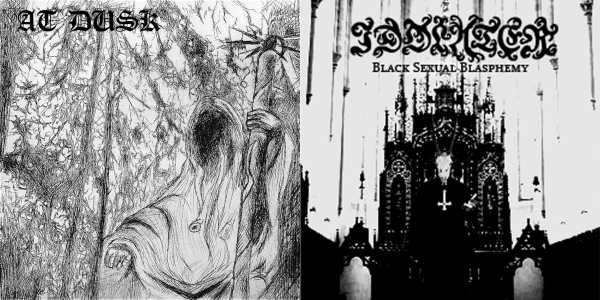
At Dusk/Idolater split [Self-Released]


The West Coast has recently been overhauled by scene-worshipping bands. Sure, I've probably ranted about "Cascadia" before, but it's really getting out of hand. I understand the appeal of the style and, sure, some of the bands are taking the style to new places and making cool music, but, in the end, they're just rerecording Weakling's "Dead as Dreams" with pagan and nature-oriented lyrics and post-rock tone sensibilities. Of course, thank heavens, Southern California has been giving me a little hope, especially with the pitch-black depths of the "Black Twilight Circle," among others.

Breaking the mold are Southern California bands, At Dusk and Idolater. At Dusk is the new project of robe-clad solo musician Korihor, also of psychedelic doom metal band Folivore, whereas Idolater, though in existence since 2000, has one full-length under its belt already (and two in the trash can).

At Dusk's side reminds me of Xasthur back in its prime ("To Violate The Oblivious") but a bit more chaotic and with an obvious psychedelic folk influence. Over the many layers of fuzzed-to-death guitar walls and distant vocals are the occasional flute lead and maybe some synthesizer pads (though it is hard to distinguish). It is nice to hear a bit of rumbling from my subwoofer whilst listening to a "depressive" black metal tape (Jon's note: whoever coined the term "depressive" black metal should be shot; what a horrible grammatical abomination), even if it is just from the kick drum. Everything is, as style dictates, soaked in reverb and delay, giving it that timeless "washed out" sound. Though At Dusk's side isn't really anything "new" stylistically, it definitely has some memorable moments (the driving "End of Being" is a real head-bobber) and I look forward to hearing more material.

Idolater's side is a bit of a challenge. Yes, the music itself is pretty awesome, perhaps a little reminiscent of seminal Swedish band Dawn, but the vocals might be a little too much. Where At Dusk has a pretty solid understanding of space between vocal lines, The Idolater doesn't really shut up, and it's a real shame. Due to his incessant anti-Christian and hypersexual lyrics, it is almost easy to miss a catchy lead or a climax. Yes, Idolater, we get that you don't like God and you'd like to do perverse things to his followers, we've heard it all before, but maybe let your music speak for you a little more next time.

So, in the end I ended up rather liking At Dusk's side of this split, which was a nice surprise, but I was left disappointed by Idolater's efforts. It is easy to understand just what he was going for, but it is easy to go overboard with the whole "Christ-raping" black metal approach. There are still some copies of the tape left if you hunt down the artists on myspace, but the original 50 copies imbued with Korihor's blood are all gone.

-Jon

Saturday, January 29, 2011

Deep Mountains - "s/t" (2010) [Pest Productions]


China is not the most orthodox place to find new black metal bands. As recently as the 1970s, it was still very difficult to find rock albums. One almost had to rely on the black market. Over the past few decades, however, it has almost exploded in contemporary musical diversity.
So, one would think that perhaps China could be a tad bit behind.

WRONG.

What this new band from Pest Productions offers the world is not only up-to-speed, but is masterful and hauntingly emotive.

There are a variety of different tempos and atmospheres, but there remains somewhat of a 'depressive black metal' aesthetic. However, I don't mean 'one-man-band-with-line-in-to-Audacity-in-his-bedroom' black metal, I mean seriously thought-out and solid riffing. And it is perfectly married to the occasional folky interlude or overdub, and also, surprisingly, bluesy solos.

What is excellent about this band is how focused it is. This self-titled album is an incredible first impression, and should also serve as quite the mascot for anyone to behold when trying to find good metal from China.

It's not just cool because it's from China. It's cool because it's just, freaking, cool.

-Elan

netra - "Mélancolie urbaine" (2010) [Hypnotic Dirge Records]


'Forward thinking music' is a statement that is every bit as much cliché as it is pinned on artists undeserving of said statement. However, once in a great while, there comes along an artist who makes no mistake in making it clear how deserving they are of the title.

netra has not only disregarded the fad of 'shoegaze/post-punk black metal' in its modern-black metal venture, but has gone into territories not often chartered by bands of genres even related to black metal.

Trip hop? Maybe a tad bit of lounge?

With many samples, differing vocal patterns, and consistently interesting percussive patterns, what we are treated to is a bleak storyline expressed through music. As depressing as it is musically enlightening, this series of tracks not only branches abroad the 'experimental black metal' territory, but somehow remains INTERESTING and ENJOYABLE. A very difficult feat to accomplish. Too often, 'experimental' means 'jumbled'. However, I am proud to report that this is not the case on this wonderful, well-thought-out, and masterful album.

Do. Not. Miss. This. Album.

-Elan

Monday, January 17, 2011

Schrei Aus Stein - "Tsisnaasjini" (2010) [Crucial Blast Records]

Her name is Mount Blanca, but the Navajo have known her for generations as "Tsisnaasjini." Forever blanketed by thick quilts of snow and obscured by mountains, it is obvious as to why the Spanish named it Blanca... yet the Navajo name, meaning "Dawn Mountain" or "White Shell Mountain" seems all the more fitting.

Utilizing this ancient name, R. Hagen's (you might remember him from Crucial Bliss drone act Encomiast) latest sonic adventure under the name Schrei Aus Stein guides the listener up the frozen monolith, showing that maybe the Spaniards got the name right, at least in color.

The album-opening "Light on Wings" trudges against the freezing wind through the snow; distant, whispered vocals echoing from snow-obscured caverns. The many layers of guitars, keyboards and field recordings are reverberated into a sepulchral mass, holding you down, pushing you back. You are freezing to death.

"Like Arctic Moons" picks up the pace, but only slightly. Again utilizing thick walls of glistening, ice-coated guitars and reverb-soaked, howling wind vocals. Moving into the fastest portion of this album, we are presented with an almost-Velvet Cacoon-like blasting section, effortlessly deconstructing itself into a metallic drone which ends the track (I like the wolf samples, too). This track is absolutely frigid, as if icicles were dangling from the moon itself.

The closer, "Vague As Blown Smoke," is by far the crown jewel of this album. Thick, black metal slush, alternating between the slow crawl of "Light on Wings" and the raw, freezing speed of "Like Arctic Moons," with a wall-of-sound quality that is comparable to playing every single Schrei Aus Stein song on top of each other. Droning on and on, however dissonant, this track is a snowstorm of pure bliss.

"Tsisnaasjini" in my opinion, is R. Hagen's reminder to everyone that he still has a background in drone, and this is a wonderful translation of his drone career into black metal. Cold enough to remind one of "the good old days" of black metal, yet forward-thinking, abstract, and, dare I say, "shoegazey" enough to be a modern black metal release, Schrei Aus Stein is "a force to be reckoned with." Packaged in a wonderful DVD case (complete with a fun postcard-related game, buttons and stickers) and limited to 250 copies, you better pick one of these up before they're gone forever! Grab it from Crucial Blast here.

-Jon

Sunday, January 16, 2011

Shape Of Despair – Written In My Scars EP [Solarfall Records] 2010


This contains two of the most fucking crushing tracks I have ever heard on a Funeral doom EP. I have been waiting for some time to hear new material from these guys and I must say this is not disappointing none what so ever. The music all together slowly drags you through a 100 levels of pure loss and misery with its atmospheric riffs and keyboards as the overwhelming weight crushes your chest.
The music is over all epic with its blending melodies and brutal guttural vocals. I can hardly begin to imagine what the follow up album to this will sound like, because this EP is that crushing for only 2 tracks. Though it have been nice to have seen at least 1 or 2 more songs on this EP because after listening to it you want to hear more. There is much creativity and potential on this one EP. I might also add that the album art is amazing and truly fits the music. With this release only on vinyl it makes it even better. This LP will do you some good to have. This is pure emotion.

-Bjørn

Wednesday, January 12, 2011

Blut Aus Nord - "The Mystical Beast of Rebellion" (2011) [Debemur Morti]


Before being handed Blut Aus Nord’s re-release of their acclaimed 2001 album The Mystical Beast of Rebellion I had no previous experience with the band’s music. I had heard the name and seen the CDs available, but had not yet listened. For me, the newer French scene (Alcest, Peste Noire etc.) is where my interest lies in regards to the music of that particular scene. The Mystical Beast of Rebellion has, for whatever reason, been chosen as a rerelease via Debemur Morti Productions with a supplementary second disc containing three tracks that comprise the seventh chapter of “The Fall” (chapters one through six comprising the track list of the original album) and new cover art.
Blut Aus Nord’s style on the original album (first disc) is good minimalist atmospheric black metal akin to Transylvanian Hunger era Darkthrone. The production lends itself well to the spirit being sought for the album and I rather enjoy its warm, sludgy fuzziness. The wall-of-sound achieved on this album is not done so much by layering as by production and allowing the guitars to breath noisily. The vocals have an eerie, lo-fi quality and are often set back in the mix while the music generally shifts between atonal dissonance and eerie, accessible melodies balanced by heavier Cletic Frost style riffing. A good example of the more dissonant elements is “Chapter III” with its tenseness and concluding metallic soundscape while “Chapter IV” gets a bit more melodic. “Chapter V” has some nice Hellhammer/early Celtic Frost style guitar bends and showcases some of the band’s heavier sensibilities.
In all, the original tracks of The Mystical Beast of Rebellion do a nice job keeping things interesting and flowing from start to finish, but I imagine most readers are more interested in what I have to say about the new supplemental material. The new tracks (all three parts of “Chapter VII”) bring something new to the table. Rather than rehashing the atmo-black feel of the original, Blut Aus Nord enters the realm of blackened doom where those elements of melody and weighty Celtic Frost inspired riffs come to the fore. Perhaps my favorite track of the entire package is the second of the new additions with its more accessible melody that has me seeing Doré engravings or Blake illuminations (as anything called “The Fall” probably should). I also enjoy the way the vocals sound like they are coming out of one of Dante’s levels of Hell (a clichéd description in black metal, but in this case they really do sound that way; kudos to the band). One of Blut Aus Nord’s strengths on this release is seeing the potential in making sparse vocals into an instrument of their own via interesting production. The final track, a nineteen minute crusher begins to lag a bit (proving that size isn’t everything), though the general ideas remain strong throughout.
I find that I enjoy this album, at least in the new presentation (as it is my first impression), but I don’t quite get what the big deal over it is. People seem to love it and Blut Aus Nord, but I can’t say it stands out as a very important atmospheric black metal release to me. I’m interested in listening to it again, and that is a good sign; it means something is calling me back to it, and that means I may come to really love it. At the moment, however, I find Blut Aus Nord’s stamp of blending of atonal and eerie music intriguing and commendable, and I am interested in hearing more of their albums, but I certainly was not floored by The Mystical Beast of Rebellion. This is one of those moments where I can only suggest listeners check it out for themselves. If you’re like me and you like atmo-black metal but have heard so much that it takes something special to make a release stand out, this is still worth the time, but it’s not necessarily spectacular. Otherwise, if you want visions of Pandæmonium and general Miltonic madness, you’re probably safe to stick with Emperor and the other greats.

-Bryan A. Wysopal

Tuesday, January 11, 2011

Panopticon - "...On the Subject of Mortality" (2010) [Lundr Records]


As soon as I first heard …On The Subject of Mortality, I knew I was in for a different experience than on Panopticon’s previous efforts. A much more melodic approach is apparent as soon as the sound clips from The Seventh Seal fade out on “Living in the Valley of the Shadow of Death.”  Clean guitar parts are very prevalent on this record and demonstrate the 90’s emo/post-rock influence on the album. A Lunn strikes a great balance between his harsh anarcho-pagan black metal sound with a new melodic, emotional feel. Clips from The Seventh Seal are present throughout the album that demonstrate the multiple layers of meaning and influence between the lyrics and artwork.
The focused musical ideas are one of the big strengths present on OTSOM. “Living Eulogy” is an example that explodes with catchy guitar melodies and furious blasting. The vocals are powerful and reach very high screams at points throughout the song. The clean atmosphere is kept alive throughout the next tracks in all the right spots.
The final two tracks on the record, “Seeing” and “Watching You” are prime showcases of the expansive soundscapes that conjure special atmospheres on the album. “Seeing” begins with bit-crushed, effected drum sounds, delayed guitar, and synth pads. It picks up to a melodic explosion of guitars and vocals which the listener can feel the true emotion in the music and lyrics. “Watching You” features guest vocals by Seidr vocalist Jack Hannert, who’s gut wrenching, Silencer-esque, howls are a perfect compliment to Lunn’s growls. Hannert’s screams are a chilling cap to the record that is a reflection of man’s mortality and the unknown that we face upon death.
After speaking to A Lunn about the concept of the record, I feel that it is the most emotional writing he has produced yet. I am very impressed by the character of the album overall and the dynamics. I feel Panopticon matured greatly with this release and love the fact that new ground has been covered instead of going backwards. I always loved the track “Speaking” from Panopticon’s self titled debut, and I’m glad that OTSOM takes that atmosphere and expands upon it while using all the influence covered by Collapse and the four splits that have been released. …On the Subject of Mortality is a fantastic record and I strongly recommend it for new Panopticon listeners or seasoned fans alike. Don’t let the fire burn out! 
-Johan

Sunday, January 9, 2011

Gholas - "Загадка" (2010) [Self-Released]


New Jersey is a pretty terrible place. Having lived on the East coast and having to take that dreadfully long bus ride from Long Island to the Allentown area to visit my grandparents was made more than marginally worse by the stench that filled the vehicle around 10 miles outside of Newark. Imagine some really rotten cheese stuffed between a hygienically-challenged man's toes, then put through an oil refinery plant. Jesus, I'm surprised my nose still retains some sense of functionality. Home to such brooding acts as Evoken and Krohm, it is obvious that the horrendous stench has permeated into the very souls of its inhabitants, yet young atmospheric sludge act Gholas must view the horrifying mediocrity that surrounds them as something so horrendous it is almost grand and majestic.

Yes, utilizing the sheer rawness and grit of early-80s "no wave" in conjunction with the ethereal grandeur of Godspeed You! Black Emperor's modern classical-tinged post-rock and the down-on-his-luck-beardy-man somber heaviness of mid-era Neurosis, Gholas prods the listener into reconsidering the horrorendously thick smog hovering over most of New Jersey as something so awful and putrid that it is almost awe-inspiring in its grandeur.

Sure, comparisons can be made to the "world being crushed under Scott Kelly's/Aaron Turner's beard" sound that has been popularized these past few years, but Gholas's crusty and at-times violent take on this popular genre hearkens back to a time where the "artcore" aspect was still fresh and new, yet still taking a backseat to what is still unmistakably heavy-as-the-goddamn-sun sludge. Don't get me wrong, I love ISIS as much as the next guy, it's just nice to hear a variant/regression with a little more, oh, cojones.

Overall: Gholas is cool, ballsy, artsy, heavy sludge. Buy their CD from them...seriously.

-Jon

Saturday, January 8, 2011

Good Weather For An Airstrike - "A Winter" (2011) [Rural Colours]

Residing in the southeastern English town of Winchester, musician and soundscape artist Tom Honey sharpens his skills at creating harmonious and somnolent pieces with his project Good Weather For An Airstrike. Scheduled for release next week on January 14th through the net label Rural Colours, "A Winter" is an EP focused on quieting the mind, especially for listeners deprived of nightly peaceful slumber. It is also intended as the first half of a larger conceptual piece, based on similar ideas and changes.

The tracks themselves certainly portray the sound Honey is going for; with the first song "Motions", the artist slowly works the minimalist orchestration up to a greater volume, sways for a bit, then brings it back down to a more softer and drawn out melody. All the while, the vocal tracking was done by a woman by the name of Jamie Brett, presumably a friendly acquaintance of Honey's. On the second track "Within a Dream", we are presented with a bit more bleak sounding piece, although it still maintains the dreamy atmosphere that was undoubtedly striven for. Concluding "A Winter" EP is the song "Broken", which echoes the Clint Mansell-esque compositional and aerial minimalism, and again features some vocal contributions by Brett.

For more information on Honey and GWFAA, I urge you to seek out his base over at MySpace, and his Bandcamp, where his "A Winter" EP shall be downloadable shortly. If you are also interested in supporting this artist via clothing, check here. At last, the lovely photographic work found with this EP can be traced to this location. Cheers.

-Shane
Related Posts Plugin for WordPress, Blogger...