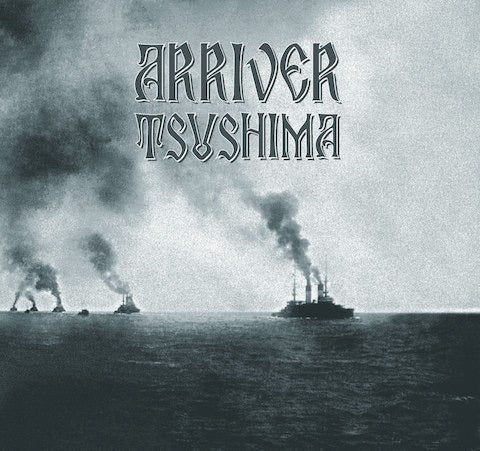
The war against happiness has come to a most bitter end. In one of the most perfect pairings I've had the pleasure of hearing, death rock's sons of doom metal Alaric and Atriarch have joined forces to wipe any feeling of warmth and self-contentment from existence. I can't even begin to tell you how excited and impatient I've been to hear this split, especially after declaring Alaric's self-titled album my absolute favorite of 2011, and when paired with Atriarch, whose Asunder-school of doom metal approach to Christian Death was the perfect stylistic complement to Alaric's doom-influenced post-punk jams, things could only get gloomier.
Starting off the split, Alaric lays down three emotionally draining slabs of their absolutely gloomiest material yet. Embracing their doom metal side further, we see Alaric slowing down even further compared to their full-length, though rather than taking the heavy route, Alaric chooses to imbue more atmosphere than bottom-heaviness. Guitarist Russ Kent's guitar tone sounds old and ragged, matching vocalist Shane's equally as gruff, mournful voice, which adds volumes to the unique sound Alaric had successfully crafted with their full-length. Even the drums, whose dull thud mimics a slow, shallow heartbeat, sound absolutely despondent. Perhaps Alaric have become more confident after the almost unanimous praise of their previous album, because there is quite a bit of branching out here. Take, for example, the almost poppy, early U2-like vocal pattern performed during the "chorus" section of "Memory Assault" or the droning, clean voice found in "Weep," which is currently top contender for "most miserable (and favorite) song of the year." It's experimenting like this, moving closer to their roots while still maintaining their slow, unique sound which keeps drawing me back to these new tracks. Alaric are still holding their spot as my favorite new band and, if the movement found within these new songs is any indicator to their future, they're bound to stay there. I believe I likened Alaric's previous work to "night music for aging punks." Well, these three songs are the hazy morning after, looking at oneself in the mirror in disgust and self-pity; a constant five o'clock shadow and ever deepening wrinkles. It's glorious.
Ever the wild card, Atriarch's two tracks definitely surprised me. After the damn near funeral pace of Forever the End, I definitely wasn't expecting them to pick up the pace for the faster direction seen in "Oblivion" and "Offerings." Moving in almost the exact opposite of splitmates Alaric, Atriarch almost entirely drop their doom metal sound (save the lengthy introduction to "Offerings") to explore more conservative deathrock ("Oblivion"), and and some rather blistering black metal ("Offerings"). Yes, black metal. I can't even begin to describe my delighted confusion when Blackhawk's extended, droning solo guitar introduction suddenly gave way to blast beats beneath his decaying four-track guitar tone. Is this the same band who refused to exceed sixty beats per minute a year ago? Certainly so, and it seems that this new, blackened direction is much kinder to vocalist Lenny's higher pitched harsh vocals, which are at their absolute prime on these new tracks. Though I was rather fond of Forever the End's mammoth, ancient doom metal, I can't help but enjoy Atriarch's ability to shapeshift while still maintaining a cohesive, indicative sound. Expect a new album from these guys on Profound Lore Records later this year - I wonder how their sound might manifest next time.
If you're planning on listening to this one, clear your schedule or make some time to browse through /r/awww, because you're going to need it. Alaric and Atriarch aren't here to make you happy, quite the contrary, so keep the Kleenex and whiskey within arm's reach. Happiness is dead, long live gloom.
Available from 20 Buck Spin on May 1st.
-Jon
Saturday, April 28, 2012
Thursday, April 26, 2012
Jute Gyte - "Impermanence" (2011) [Jeshimoth Entertainment]
It was only a matter of time until a modern music composition nerd would make his mark on black metal. Black metal's bombast, like many other genres, has manifested itself as an offshoot of Romantic classical music. Yes, many people fail to really notice it, but most modern music is still deeply rooted in composition techniques revolutionized by the likes Richard Wagner, Frederic Chopin, and Franz Liszt in the mid-to-late 1800s. Seeing as this approach to music is still rather broad and is comprised of an extensive array of techniques (which can be arranged in a seemingly infinite amount of combinations), we members of the modern age haven't really needed to expand into the realm of modern/avant-garde music in the way we treat Romantic and post-Romantic theory. However, a select few artists must not have gained true fulfillment with our "old ways" standards of popular music, leading to a new, scattered generation of artists the likes of Krallice, whose grandiose, Paul Hindemithian guitar counterpoint has been critically praised as some of the most innovative in metal-oriented music, and Ehnahre, a death/doom trio with roots buried deep in Bela Bartok and George Crumb's mathematical, "shaped" modern classical music.
Perhaps not as well known as the previously mentioned acts, Missouri musician and scholar Adam Kalmbach has been quietly producing a staggering amount of music, ranging from Stockhausen-inspired electronics to brain-bending black metal, under the name Jute Gyte. Now, it's only been eight months or so since I discussed the "extravagance" of Kalmbach's Verstiegenheit, and already he's released five full-length albums, including his fourth foray into black metal, the bizarre Impermanence.
I may have considered Verstiegenheit's intense, well thought-out polytonal guitar work and mathematically planned time signatures to be a challenging listen, but I never could have imagined the great lengths Kalmbach had planned to stretch "challenging" with his future works. Again featuring his now-signature "modern" guitar work, one will find Jute Gyte's Impermanence to have more in common with Russian composer Igor Stravinsky, whose ballet "The Rites of Spring" attained legendary status when it's opening performance incited a riot, than any other predecessor in black metal history. Unlike Verstiegenheit, it seems Kalmbach has chosen to stay away from odd time signatures, or has maybe ditched the idea of meter in general. Pulsing, industrial drums push the music forward, while jagged guitars spider their way about with phrasing so bizarre it seems more likely that Kalmbach completely through-composed these tracks, almost never returning to a previous idea. Elements of the non-metal Jute Gyte material has seemingly worked its way into Impermanence with the occasional added noise texture and the exceedingly strange use of lap steel slide guitar. Is this the beginning of the end for Jute Gyte's dichotomous existence as a noise and black metal artist? I certainly wouldn't mind seeing more fusion like this in future releases.
The care and rigorous attention to detail Kalmbach put into crafting such jarring, disjointed music while following the guidelines set forth by the modern masters is the sign of a well-studied "music nerd." As a music nerd myself (getting my degree certification in a little over a month), I wholeheartedly appreciate Adam Kalmbach's efforts with Jute Gyte, both as a scholar and a fan of music. However "intelligent" this music may be, I have a feeling fans of Vindsval's work with Blut aus Nord, especially the last two albums, will definitely take a shine to this. As it has been with every other Jute Gyte release, Impermanence is available for free from his Bandcamp, but you should probably buy this.
-Jon
Perhaps not as well known as the previously mentioned acts, Missouri musician and scholar Adam Kalmbach has been quietly producing a staggering amount of music, ranging from Stockhausen-inspired electronics to brain-bending black metal, under the name Jute Gyte. Now, it's only been eight months or so since I discussed the "extravagance" of Kalmbach's Verstiegenheit, and already he's released five full-length albums, including his fourth foray into black metal, the bizarre Impermanence.
I may have considered Verstiegenheit's intense, well thought-out polytonal guitar work and mathematically planned time signatures to be a challenging listen, but I never could have imagined the great lengths Kalmbach had planned to stretch "challenging" with his future works. Again featuring his now-signature "modern" guitar work, one will find Jute Gyte's Impermanence to have more in common with Russian composer Igor Stravinsky, whose ballet "The Rites of Spring" attained legendary status when it's opening performance incited a riot, than any other predecessor in black metal history. Unlike Verstiegenheit, it seems Kalmbach has chosen to stay away from odd time signatures, or has maybe ditched the idea of meter in general. Pulsing, industrial drums push the music forward, while jagged guitars spider their way about with phrasing so bizarre it seems more likely that Kalmbach completely through-composed these tracks, almost never returning to a previous idea. Elements of the non-metal Jute Gyte material has seemingly worked its way into Impermanence with the occasional added noise texture and the exceedingly strange use of lap steel slide guitar. Is this the beginning of the end for Jute Gyte's dichotomous existence as a noise and black metal artist? I certainly wouldn't mind seeing more fusion like this in future releases.
The care and rigorous attention to detail Kalmbach put into crafting such jarring, disjointed music while following the guidelines set forth by the modern masters is the sign of a well-studied "music nerd." As a music nerd myself (getting my degree certification in a little over a month), I wholeheartedly appreciate Adam Kalmbach's efforts with Jute Gyte, both as a scholar and a fan of music. However "intelligent" this music may be, I have a feeling fans of Vindsval's work with Blut aus Nord, especially the last two albums, will definitely take a shine to this. As it has been with every other Jute Gyte release, Impermanence is available for free from his Bandcamp, but you should probably buy this.
-Jon
Wednesday, April 25, 2012
Mutilation Rites - "I Am Legion" (2012) [Gilead Media]
East coast black metal quartet Mutilation Rites have been ascending the rungs of popularity's ladder rather quickly over the past year. After two impressive self-released CDr's and a monstrous split with Batillus, Mutilation Rites suddenly manifested on Wisconsin "thought-provoking metal" label Gilead Media's roster and, more recently, have joined the Prosthetic Records family. After seeing them perform with Lord Mantis, Batillus, and Sourvein in Chicago last July, I found myself in complete agreement with their popularity, but who couldn't deny themselves a nice, solid, undeniably American black metal band who pays homages to the right source material?
At a mere 17 minutes in length, the single-sided LP I Am Legion, released late last month on Gilead Media, is a short, sharp, shock of powerful, droning black metal. The three tracks presented, titled "Cloaca Maxima," "Blood Will Tell," and "Terrestrial Hell," are all re-worked, re-recorded versions of previous demo tracks, which were already pretty solid. While the material on this EP (Is it an EP? Is "One-sided 12-inch" a new length-based format?) isn't necessarily anything super new-sounding, taking more than a few pages out of the book written by Ihsahn and John Gossard in the 1990s, I Am Legion is still a pretty enjoyable listen. Sonically, even if they aren't reinventing the wheel by any means, this is still pretty solid, especially in the bass department. Maybe people still have an aversion to bass to recreate the tinny, direct-to-4 track sound of the 1990s, which is respectable, but it's nice to have some low-frequency "oomph"s to remind me that, yes, we are in 2012. Mutilation Rites are fine by me.
So yeah, as I said earlier, I Am Legion isn't really anything new, but it's performed well and sounds great. Mutilation Rites aren't out there to really change anything, anyway - I'm pretty sure they just want to play black metal. Apparently this LP, whose artwork is done by our buddy Rainbath Visual, comes with some nice goodies, including a patch and a button (I love extra goodies like that). I'll be seeing these guys, along with loads of other awesome bands, at Day 2 of Gilead Media Fest, which starts in three, yes, three days. Who will I see at extreme metal's most unlikely festival home in Oshkosh, Wisconsin?
-Jon
At a mere 17 minutes in length, the single-sided LP I Am Legion, released late last month on Gilead Media, is a short, sharp, shock of powerful, droning black metal. The three tracks presented, titled "Cloaca Maxima," "Blood Will Tell," and "Terrestrial Hell," are all re-worked, re-recorded versions of previous demo tracks, which were already pretty solid. While the material on this EP (Is it an EP? Is "One-sided 12-inch" a new length-based format?) isn't necessarily anything super new-sounding, taking more than a few pages out of the book written by Ihsahn and John Gossard in the 1990s, I Am Legion is still a pretty enjoyable listen. Sonically, even if they aren't reinventing the wheel by any means, this is still pretty solid, especially in the bass department. Maybe people still have an aversion to bass to recreate the tinny, direct-to-4 track sound of the 1990s, which is respectable, but it's nice to have some low-frequency "oomph"s to remind me that, yes, we are in 2012. Mutilation Rites are fine by me.
So yeah, as I said earlier, I Am Legion isn't really anything new, but it's performed well and sounds great. Mutilation Rites aren't out there to really change anything, anyway - I'm pretty sure they just want to play black metal. Apparently this LP, whose artwork is done by our buddy Rainbath Visual, comes with some nice goodies, including a patch and a button (I love extra goodies like that). I'll be seeing these guys, along with loads of other awesome bands, at Day 2 of Gilead Media Fest, which starts in three, yes, three days. Who will I see at extreme metal's most unlikely festival home in Oshkosh, Wisconsin?
-Jon
Tuesday, April 24, 2012
Mats Gustafsson - "Bengt" (2012) [Utech Records]
We're certainly on a roll with top-quality albums. So, straight into Bengt.
Bengt is not Gustafsson's Needs! (2010), with its heavy use of electronics--Bengt actually contains no electronics and no discernable overdubbing. Nor is it the standard popular impression of Mats Gustafsson, the screaming madman Brötzmann foreshadowed. It's still not the most accessible record, but it's pretty clearly a work of a focused master.
On Bengt, Gustafsson is simultaneously exploring the limits of timbral experimentation through extended technique and giving tribute to the New Music of the 60's and 70's. The title refers to Bengt Nordström, known best for producing Ayler's Something Different and more significant to Mats Gustafsson as a longtime mentor. Basically, Gustafsson spends just short of 40 minutes displaying usually pointillist explorations of every imaginable extended saxophone technique, infrequently interspersed with surprising moments of accessible melody. Surprising not only because of the tendency towards shrieking and atonal bursts, but because the sounds Gustafsson spurts are usually completely devoid of any intention to create a sense of flow or continuity.
Gustafsson has a great sense of melody, though. Every little bit, when melody exists at all, is both drenched in jazz feeling (think back to the days BEFORE free jazz was dedicated to timbral exploration) and simultaneously wrapped in techniques you'd never hear anywhere else. He manages not only to wring personality and emotion out of those raw edges, but manages somehow to approximate parallel octaves while playing a melody--not exactly something one expects with an instrument whose harmony is itself an extended technique.
Solo saxophone, because of its necessary sparsity (though Rolf-Erik Nystrøm might argue that point) is certainly not the most easily engaged genre, and Gustafsson's aesthetic goals only infrequently coincide with those found in the majority of musical history. However, Bengt is a masterwork of the distinctive aesthetic it creates and is a deep trench of inspiration for any modern composer or performer. Congratulations, Utech.
-V.
Bengt is not Gustafsson's Needs! (2010), with its heavy use of electronics--Bengt actually contains no electronics and no discernable overdubbing. Nor is it the standard popular impression of Mats Gustafsson, the screaming madman Brötzmann foreshadowed. It's still not the most accessible record, but it's pretty clearly a work of a focused master.
On Bengt, Gustafsson is simultaneously exploring the limits of timbral experimentation through extended technique and giving tribute to the New Music of the 60's and 70's. The title refers to Bengt Nordström, known best for producing Ayler's Something Different and more significant to Mats Gustafsson as a longtime mentor. Basically, Gustafsson spends just short of 40 minutes displaying usually pointillist explorations of every imaginable extended saxophone technique, infrequently interspersed with surprising moments of accessible melody. Surprising not only because of the tendency towards shrieking and atonal bursts, but because the sounds Gustafsson spurts are usually completely devoid of any intention to create a sense of flow or continuity.
Gustafsson has a great sense of melody, though. Every little bit, when melody exists at all, is both drenched in jazz feeling (think back to the days BEFORE free jazz was dedicated to timbral exploration) and simultaneously wrapped in techniques you'd never hear anywhere else. He manages not only to wring personality and emotion out of those raw edges, but manages somehow to approximate parallel octaves while playing a melody--not exactly something one expects with an instrument whose harmony is itself an extended technique.
-V.
Wreck and Reference - "No Youth" (2012) [Self-Released]
We are entering a new era. As a guitarist, I'm surprised I didn't touch upon this the last time I gushed about California doomnoise duo Wreck and Reference, but, after forty years of existence, one would think a new instrument would have begun to catch up with the guitar in metal. When one looks at the overall history of composed music, performing forces were a rather fluid ordeal, with new instruments evolving out of a desire for a new timbre, sound, or sonic range. To put this into perspective with a highly simplified example, out of necessity, the common ancestor of the Western bowed string instrument class's range was deemed too limited, giving birth to higher and lower ranged instruments, which eventually became the violin, viola, cello, and bass. Granted, most of these changes happened over much longer periods of time than the forty years in which metal's love affair with guitar (and bass guitar) has been around, but, with today's ever forward-thinking societal expectations, one would think some brave individual would have stepped forward and said, "Hey, you guys with the long hair! Check this out!," bringing about a new direction in music, yet, until last year, just about everyone has failed to do.
Around a year ago a challenger appeared, wielding not an axe, but a sample pad. That's right, folks, in Wreck and Reference you will hear no guitars, bass, or keyboard, rather an arsenal of carefully crafted samples compiled by sample pad master/vocalist Felix Skinner and drummer Ignat Frege. Naturally, I can see this new approach to metal, let alone doom metal, to be a little off-putting to most in theory. Doom metal has always been about the guitar, ever since Tony Iommi detuned his own to compensate for his significant lack in fingertips, and yetYouth (pronounced "No Youth"), Wreck and Reference' debut full-length album, is a stunning, undeniable bout of doomed, electronics-based metal.
A much more sophisticated, aggressive affair than their thrice-released Black Cassette demo, we see Skinner's use of samples evolving, distancing themselves from the demo's always-melodic, guitarlike sounds for something much noisier and more sinister, something which wouldn't sound out of place in early Swans's mechanical early material. Large washes of noise and deep pad synths are the norm here, rhythmically pulsing along with Frege's adventurous, solid drumming and Skinner's versatile voice, ranging from a shaky, timid clean murmur to a distressed scream. This truly is unlike anything I've ever heard, and in an extremely positive way. Normally bands like this who imbue themselves with a "new genre" (I'm pretty sure no one else could get away with calling themselves "electronic doom metal") simply get tossed into the "gimmick" pile, but Wreck and Reference are so much more than that. The passion and intensity of doom metal are there, but with the attention to detail only someone with extreme obsessive compulsive disorder and a really nice Padkontrol sample pad can achieve. Of course, this album isn't just "doom metal" like their title says, rather this time the duo ventures outside the Mount Eerie and Have a Nice Life jamming with Neurosis sound niche they carved with their demo, taking on elements of neofolk, power electronics, and there are some especially impressive black metal-inspired sections strewn throughoutYouth.
It's not very often an album can tilt my head but keep pulling me in likeYouth has, which is a defining statement to the album's character. Wreck and Reference's new, legitimately progressive take on a tried and true style of music is absolutely one of a kind and wholly deserving of all the praise I've seen it get throughout the blogosphere. Hopefully some benevolent, awesome label will pick them up, because I definitely wouldn't mind hearing this one on wax, but, for now, Skinner and Frege have made this album available to you, the listener, for FREE.
Who needs a guitar, anyway?
-Jon
Around a year ago a challenger appeared, wielding not an axe, but a sample pad. That's right, folks, in Wreck and Reference you will hear no guitars, bass, or keyboard, rather an arsenal of carefully crafted samples compiled by sample pad master/vocalist Felix Skinner and drummer Ignat Frege. Naturally, I can see this new approach to metal, let alone doom metal, to be a little off-putting to most in theory. Doom metal has always been about the guitar, ever since Tony Iommi detuned his own to compensate for his significant lack in fingertips, and yet
A much more sophisticated, aggressive affair than their thrice-released Black Cassette demo, we see Skinner's use of samples evolving, distancing themselves from the demo's always-melodic, guitarlike sounds for something much noisier and more sinister, something which wouldn't sound out of place in early Swans's mechanical early material. Large washes of noise and deep pad synths are the norm here, rhythmically pulsing along with Frege's adventurous, solid drumming and Skinner's versatile voice, ranging from a shaky, timid clean murmur to a distressed scream. This truly is unlike anything I've ever heard, and in an extremely positive way. Normally bands like this who imbue themselves with a "new genre" (I'm pretty sure no one else could get away with calling themselves "electronic doom metal") simply get tossed into the "gimmick" pile, but Wreck and Reference are so much more than that. The passion and intensity of doom metal are there, but with the attention to detail only someone with extreme obsessive compulsive disorder and a really nice Padkontrol sample pad can achieve. Of course, this album isn't just "doom metal" like their title says, rather this time the duo ventures outside the Mount Eerie and Have a Nice Life jamming with Neurosis sound niche they carved with their demo, taking on elements of neofolk, power electronics, and there are some especially impressive black metal-inspired sections strewn throughout
It's not very often an album can tilt my head but keep pulling me in like
Who needs a guitar, anyway?
-Jon
Duane Pitre - "Feel Free" (2012) [Important Records]
Like a leisurely walk through an empty Zen garden, Duane Pitre's latest effort is an exercise in modal relaxation. Following up his 2007 effort on Important, the majestic and transcendent drone poem "Organized Pitches Occurring in Time," "Feel Free" finds Pitre reaching for something slightly more aggressive and brittle, emerging out of the considerable din with a piece that is both lulling and thoroughly engaging. The five sections on this record dress themselves in the guises of modern classical, but they're really explorations of prepared guitar and avant-improv, not dissimilar to Kevin Drumm's earlier guitar-based recordings (though far more compositionally complex.) Pitre's music is obviously a product of planning and speculation, despite the majority of the performances comprising it being open-ended wandering by the players involved. The result is a beautifully organic LP that flows and floats, lazy without being complacent.
"Feel Free" is based around pre-recorded guitar string harmonics in Just Intonation played by a computer in random order around which a performer or various performers can add to improvisationally. Whether they work with the harmonics or against them is the beauty of the piece; the performers can "feel free" to do as they like, creating either total discordance and cacophany or lullaby soothe. The players on this particular version of the piece mostly opt for the latter approach, working with Pitre's prepared harmonics in a way that almost defies spontaneous interpretation. Things are spacious but full of sound, busy but never grating. Stringed instruments behave in a distinctly percussive way, rebelling against preconception and giving way to unique reimaginings. The five pieces that make up "Feel Free" have a marked dreaminess, a sort of malleability that washes in and out without ever really letting go. There is an ebb and tide, a push and pull, a dark and light-but the composition never gives itself fully to any of these moods, instead choosing to reside in a mysterious and lovely middle place betwixt a rainbow of tones.
Lest one accuse Pitre of aimless atonal wandering, his approach has always been one of layering and building. Taking cues from classic demonstrations of musique concrete, Pitre understands the power of sounds placed together with one another, whether in juxtaposition or cooperation. There is magic in chaos just as there is harmony in peace; the composer's ultimate job is to place those elements in an order and manner that will evoke a specific intent or emotion. In light of that, Pitre paces "Feel Free" so that it works as both a provocation and a placation. The wealth of notes, tones, and sensibilities that define the piece across its first two-thirds represent the vastness of subjectivity, an allowance few modern composers give to their works. Those that succumb will be rewarded.
Towards the end of the piece, Pitre's ensemble retreats into a massive onslaught of bowing drone and string whine, a gorgeous, thick marriage of melodies and strains that twists in upon itself over and over, creating a swirling roar of buzzing bliss. It happens so naturally, flowing from the plinks and plucks of the forms before, that you barely notice what's taken place until you're drowning in a sea of uber-layered constants that gets deeper and deeper. Pitre is in full-on master mode here, transforming the staunch unapproachability of neoclassical posturing into something totally and utterly enveloping, the purity of sound for its own sake, the wonder of simply being, of presence in a particular moment-the sheer joy of the spectacle. Whether it's the philosophical grandeur of life or the ever-changing nature and idea of music itself, "Feel Free" works with it and comments on it. This is a piece that is joyously, unabashedly alive. Listening to it is nothing less than a rejuvenation. Or perhaps meditation. The actual decision lies with you.
-Cory
"Feel Free" is based around pre-recorded guitar string harmonics in Just Intonation played by a computer in random order around which a performer or various performers can add to improvisationally. Whether they work with the harmonics or against them is the beauty of the piece; the performers can "feel free" to do as they like, creating either total discordance and cacophany or lullaby soothe. The players on this particular version of the piece mostly opt for the latter approach, working with Pitre's prepared harmonics in a way that almost defies spontaneous interpretation. Things are spacious but full of sound, busy but never grating. Stringed instruments behave in a distinctly percussive way, rebelling against preconception and giving way to unique reimaginings. The five pieces that make up "Feel Free" have a marked dreaminess, a sort of malleability that washes in and out without ever really letting go. There is an ebb and tide, a push and pull, a dark and light-but the composition never gives itself fully to any of these moods, instead choosing to reside in a mysterious and lovely middle place betwixt a rainbow of tones.
Lest one accuse Pitre of aimless atonal wandering, his approach has always been one of layering and building. Taking cues from classic demonstrations of musique concrete, Pitre understands the power of sounds placed together with one another, whether in juxtaposition or cooperation. There is magic in chaos just as there is harmony in peace; the composer's ultimate job is to place those elements in an order and manner that will evoke a specific intent or emotion. In light of that, Pitre paces "Feel Free" so that it works as both a provocation and a placation. The wealth of notes, tones, and sensibilities that define the piece across its first two-thirds represent the vastness of subjectivity, an allowance few modern composers give to their works. Those that succumb will be rewarded.
Towards the end of the piece, Pitre's ensemble retreats into a massive onslaught of bowing drone and string whine, a gorgeous, thick marriage of melodies and strains that twists in upon itself over and over, creating a swirling roar of buzzing bliss. It happens so naturally, flowing from the plinks and plucks of the forms before, that you barely notice what's taken place until you're drowning in a sea of uber-layered constants that gets deeper and deeper. Pitre is in full-on master mode here, transforming the staunch unapproachability of neoclassical posturing into something totally and utterly enveloping, the purity of sound for its own sake, the wonder of simply being, of presence in a particular moment-the sheer joy of the spectacle. Whether it's the philosophical grandeur of life or the ever-changing nature and idea of music itself, "Feel Free" works with it and comments on it. This is a piece that is joyously, unabashedly alive. Listening to it is nothing less than a rejuvenation. Or perhaps meditation. The actual decision lies with you.
-Cory
Pinkish Black - "Pinkish Black" (2012) [Handmade Birds Records]
With the "hypetrain" mentality of so many labels in music's current era, it's nice to see an underdog receiving so much positive attention. I see so many "controversial" blogroll bands being picked up by "bigger" labels that it almost defeats the purpose of finding new bands. We already know about them! It all seems rather lazy, waiting for some musical act to gain notoriety before deciding to snatch them up. I thought independent labels were all about the underdog, the new, fantastic artist who spits in the face of convention and helps redefine what a "scene" might consider music. That's not to say already popular bands don't deserve the credit of being picked up by a new label; I mean, if they worked hard, then, by all means, a bigger label is definitely the route to take, I just feel like we seem to be stuck in a sort of rut right now, which is why I find Handmade Birds's upcoming release, Texas deathrock newcomers Pinkish Black, to be one of the most exciting releases of this year.
After my various post-punk-related reviews and features over the past few months, my love of deathrock/post-punk/goth rock/peace punk/lots of other slashes should be pretty apparent, but Pinkish Black definitely takes the cake for "most intriguing" post-punk band I've heard in quite some time. Stripping instrumentation down to a single voice, an arsenal of synthesizers, and a drum kit, Pinkish Black's "bad acid trip" psychedelia could be considered akin to early Nick Cave band The Birthday Party on even more drugs or if Danny Elfman's old band Oingo Boingo was launched even further into space. With only three key elements to the band itself, entirely lacking a bass guitar in any shape or form, many post-punk purists (aside from synthwave fans) will definitely be turned off, but only at first. What's deathrock without a bass guitar, anyway? Well, have no fear, my eyeliner-clad friends, because Pinkish Black do the style justice with a multi-layered, "full band" sound, mastered perfectly by the great, always busy James Plotkin (who has a collaboration with percussionist Jon Mueller coming out this summer on Taiga Records, but more on that later).
Everything on Pinkish Black's self-titled debut is decidedly dark, be it the buried vocals, the grating, low-end synthesizers, or the song titles themselves, boasting names like "Tell Her I'm Dead," "Tastes Like Blood," or "Bodies in Tow," but, when the band's name itself refers to a former band member's suicide (apparently the walls were "Pinkish Black" with gore), darkness only seems appropriate. Naturally, the musical partnership of Jon Teague, whose name you might remember from Texas band Yeti, and Daron Beck takes their own negativity above and beyond, leaving behind traditional deathrock leanings to embrace doom metal's sinister crawl and, for a brief, shining (perhaps not the best word to associate with this band) moment in "Tell Her I'm Dead," Teague injects a few cc's of adrenaline straight to the song's jugular, bringing the band to a mid-paced, blackened blur, atmospherically paired with the only harsh vocal delivery on the whole album, handled by Beck. Oh, and what deathrock album would be complete without an homage to the the style's forefathers, the great Christian Death? It turns out the first 100 preorders come with a floppy disk (weird, but I can deal) containing a masterful "Spiritual Cramp" cover.
Pinkish Black is a brave outing into an otherwise conservative genre (amazing that a style championed by anarchists could be so rigid), but their masterful approach toward atmosphere and texture could definitely garner Beck and Teague some hope as the "dark horse" on many a year end list. I'm definitely glad Handmade Birds' sole proprietor R. Loren reached out to such a fantastic local band - hopefully his adventurousness will lead to the discovery of more quality "hometown" bands. If you didn't listen to Pitchfork, at least take my word for it - this is a killer album. Pre-order now from Handmade Birds.
-Jon
After my various post-punk-related reviews and features over the past few months, my love of deathrock/post-punk/goth rock/peace punk/lots of other slashes should be pretty apparent, but Pinkish Black definitely takes the cake for "most intriguing" post-punk band I've heard in quite some time. Stripping instrumentation down to a single voice, an arsenal of synthesizers, and a drum kit, Pinkish Black's "bad acid trip" psychedelia could be considered akin to early Nick Cave band The Birthday Party on even more drugs or if Danny Elfman's old band Oingo Boingo was launched even further into space. With only three key elements to the band itself, entirely lacking a bass guitar in any shape or form, many post-punk purists (aside from synthwave fans) will definitely be turned off, but only at first. What's deathrock without a bass guitar, anyway? Well, have no fear, my eyeliner-clad friends, because Pinkish Black do the style justice with a multi-layered, "full band" sound, mastered perfectly by the great, always busy James Plotkin (who has a collaboration with percussionist Jon Mueller coming out this summer on Taiga Records, but more on that later).
Everything on Pinkish Black's self-titled debut is decidedly dark, be it the buried vocals, the grating, low-end synthesizers, or the song titles themselves, boasting names like "Tell Her I'm Dead," "Tastes Like Blood," or "Bodies in Tow," but, when the band's name itself refers to a former band member's suicide (apparently the walls were "Pinkish Black" with gore), darkness only seems appropriate. Naturally, the musical partnership of Jon Teague, whose name you might remember from Texas band Yeti, and Daron Beck takes their own negativity above and beyond, leaving behind traditional deathrock leanings to embrace doom metal's sinister crawl and, for a brief, shining (perhaps not the best word to associate with this band) moment in "Tell Her I'm Dead," Teague injects a few cc's of adrenaline straight to the song's jugular, bringing the band to a mid-paced, blackened blur, atmospherically paired with the only harsh vocal delivery on the whole album, handled by Beck. Oh, and what deathrock album would be complete without an homage to the the style's forefathers, the great Christian Death? It turns out the first 100 preorders come with a floppy disk (weird, but I can deal) containing a masterful "Spiritual Cramp" cover.
Pinkish Black is a brave outing into an otherwise conservative genre (amazing that a style championed by anarchists could be so rigid), but their masterful approach toward atmosphere and texture could definitely garner Beck and Teague some hope as the "dark horse" on many a year end list. I'm definitely glad Handmade Birds' sole proprietor R. Loren reached out to such a fantastic local band - hopefully his adventurousness will lead to the discovery of more quality "hometown" bands. If you didn't listen to Pitchfork, at least take my word for it - this is a killer album. Pre-order now from Handmade Birds.
-Jon
Labels:
2012,
Jon,
Pinkish Black,
Post-Punk,
Review
Sunday, April 22, 2012
Benighted in Sodom - "A Premonition of Miracles Undone" (2012) [Solitude Productions]
It is always a shame to see a band go. Reuben "Matron Thorn" Jordan's Benighted in Sodom project has been a consistent source of some of the most unique, distinct music on the dark, blackened end of the metal spectrum. Known to release multiple albums and unannounced EPs within a year's span, Benighted in Sodom's consistent, yet constantly evolving, sound proved Jordan to be the one of the first to incorporate such alien styles as darkwave and post-punk into black metal, placing Benighted in Sodom alongside the neo-French "post-black metal" scene's beginnings. Sadly, after eight years of activity, Jordan has decided to end Benighted in Sodom, leaving behind hours of unfinished works and one final album, A Premonition of Miracles Undone.
Initially intended as the third and final chapter of the In Hora Maledictus triptych, whose first two parts were released in 2008 and 2009, A Premonition of Miracles Undone stands as the strongest release in Benighted in Sodom's sprawling "thirty-three something" part discography. All the expected Benighted in Sodom elements are here, the warbly guitar tone, Jordan's crystal clear diction, and an obsession with the 1980s goth subculture, which manifests itself at its most apparent on the gloomy mid-paced "Oneiric Eternity." However, even with the troves of synthesizers and miserable dance beats, Jordan manages to tap into the aggression found in the earlier In Hora Maledictus chapters, and maybe far enough back to cite his raw work on Plague Overlord. On "Aberration," one of the album's more aggressive, blasting moments, Jordan steps back from the microphone to lend his project a new voice, that of Woe's Chris Grigg, whose chaotic, almost grindcore-suited screams fit perfectly alongside quick-wristed session drummer Gionata Potenti, who's been on too many records to name.
As far as "final" albums go, it is comforting to see Benighted in Sodom leaving on a high point. So many bands wait until they've gone so far South that not even a "farewell" tour couldn't forgive their transgressions against music, but A Premonition of Miracles Undone stands as Benighted in Sodom's most concentrated work. Moving the Maledictus series to a close, the morally deprived anti-hero is transfigured into a "purified malevolent entity," as Jordan told me in an interview a few years back, ultimately becoming the epitome of pain and negativity. "Much, much pain," he adds, and it is true. The depressed atmosphere is intoxicating, making the pain this entity experiences almost tangible. With every new aspect of his transformation comes new scars and unspeakable misery. A fitting, almost allegorical ending to Benighted in Sodom, whose depraved, hedonistic approach to "gothic" black metal, A Premonition of Miracles Undone has brought about the end of our anti-hero's story, and ultimately cut the project itself's thread short. Thank you, Benighted in Sodom, for many years of quantity and quality.
-Jon
Initially intended as the third and final chapter of the In Hora Maledictus triptych, whose first two parts were released in 2008 and 2009, A Premonition of Miracles Undone stands as the strongest release in Benighted in Sodom's sprawling "thirty-three something" part discography. All the expected Benighted in Sodom elements are here, the warbly guitar tone, Jordan's crystal clear diction, and an obsession with the 1980s goth subculture, which manifests itself at its most apparent on the gloomy mid-paced "Oneiric Eternity." However, even with the troves of synthesizers and miserable dance beats, Jordan manages to tap into the aggression found in the earlier In Hora Maledictus chapters, and maybe far enough back to cite his raw work on Plague Overlord. On "Aberration," one of the album's more aggressive, blasting moments, Jordan steps back from the microphone to lend his project a new voice, that of Woe's Chris Grigg, whose chaotic, almost grindcore-suited screams fit perfectly alongside quick-wristed session drummer Gionata Potenti, who's been on too many records to name.
As far as "final" albums go, it is comforting to see Benighted in Sodom leaving on a high point. So many bands wait until they've gone so far South that not even a "farewell" tour couldn't forgive their transgressions against music, but A Premonition of Miracles Undone stands as Benighted in Sodom's most concentrated work. Moving the Maledictus series to a close, the morally deprived anti-hero is transfigured into a "purified malevolent entity," as Jordan told me in an interview a few years back, ultimately becoming the epitome of pain and negativity. "Much, much pain," he adds, and it is true. The depressed atmosphere is intoxicating, making the pain this entity experiences almost tangible. With every new aspect of his transformation comes new scars and unspeakable misery. A fitting, almost allegorical ending to Benighted in Sodom, whose depraved, hedonistic approach to "gothic" black metal, A Premonition of Miracles Undone has brought about the end of our anti-hero's story, and ultimately cut the project itself's thread short. Thank you, Benighted in Sodom, for many years of quantity and quality.
-Jon
Circle - "Manner" (2012) [Hydrahead]
Following almost immediately after the release of live document "Serpent," Circle returns with their debut album for Hydrahead, the somewhat restrained "Manner." I have a hard time not viewing the two records as companion pieces, as "Serpent" featured four of the tracks that make up "Manner," meaning this new record is really just a bit of catch-up for the band. Considering that "Serpent" was a much more raucous, adrenalin-fueled affair, "Manner" risks being relegated to the "interesting but inessential" corner of Circle's immense discography. That's not to the band's or Hydrahead's discredit-it's just a matter of Circle's ridiculously prolific output. Had this one come first, my opinion of it may have been different. It's moderately passable, but when the studio takes are weighed against the vicious live deliveries on "Serpent" they fail to match the former's breakneck intensity.
Circle seems to understand this-virtually half (if not more) of their catalogue is made up of live recordings. Their incredible improvisational skill practically guarantees they'll slay in the live arena, and their equally far-reaching musical interests means that two hours of Circle unhindered by studio constraint is going to obliterate anything that could have been crafted within walls. Live the songs become beings unto themselves, defined but not confined by their recorded versions, mere templates for exploration. Circle is a band that reaches for the cosmos and usually gets there most every time they take the stage, but those moments and experiments that define the energy and transcendent quality of a Circle gig don't always translate well to the album format. "Manner" is a perfect example.
Much like on "Serpent," "Manner" opens with "Lintu Joe," and it's not an entirely good indicator of the direction the band's going to head in (if there's any actual direction at all, which there doesn't seem to be.) The song plods along at a weird stop/start hiccup, reveling in its own approximation of Uriah Heap style power chord majesty and a schizophrenic sense of the progressive. Blazing rocker "Blue King" is up next, rehashing Judas Priest type-riffage and hardcore velocity in service of NWOFHM glory. It's easily the record's highlight (compared to its placement on "Serpent," where it's tacked on towards the end in a furious dervish of rock onslaught and almost whizzes by unheralded) and reiterates how wickedly metal Circle can be when they want. It almost sounds like an outtake from Pharaoh Overlord's arena-metal worshiping shredfest "Out of Darkness," but where Pharaoh Overlord's approach is entirely tongue in cheek, Circle's is dead serious. Side A closes out with a cover of Brian Eno's "Here Come the Warm Jets," another track that totally kills on "Serpent" but seems tepid and tired here. Gone is the gargantuan monolithism of the band's live take, replaced by twinkling guitars and muted force, an eight minute run-through that builds up to nothing other than a grand sputtering out. On "Serpent" it threatens to swallow all that came before in a swirl of thick distortion and soothing vocal mesmerization-on "Manner" that immersion is transformed into background music.
Side B is even less remarkable, the only track of note being the other "rocker," "Mustaa Kultaa." Taking rock and roll reference to a bizarre outre point, the track barrels across on a raft of post-Nugent regurgitation and an avalanche of guitar solos, resulting in a holy mess of rock glory. It's less effective than its live counterpart, but it's got a venom to it that the rest of the side's tracks lack. "New Fantasy" and "Potero" are both convoluted wishy-washy prog/power metal-bloats that seem more intent on providing an intro to Circle's weirdness for the Hydrahead crowd than they do being serviceable compositions in their own right. "Potero" especially seems strange for the sake of it, a rollercoaster mash up of 1980s Journey-esque fanfare with Frank Zappa style vocal histrionics, thrown together in an indelicate balance of extremes. Sometimes this shit works wonderfully for Circle (see their recent album "Infektio" or the icy jazz atmospheres of "Miljard") but here it's just a boring trip through the usual bag of tricks.
"Manner" isn't awful. It simply isn't great. It feels to me more like an introduction to Circle for American audiences unfamiliar with them; in that sense Hydrahead has given us a decent profile of one of modern rock's most consistently interesting and mind-blowing units. As an album proper, though, it fails to have the power of something like "Prospekt" or "Sunrise." If you were interested in hearing these songs, I would heavily recommend the versions found on "Serpent"-you get the majority of "Manner" plus a number of classic Circle live jams all trussed up in the guise of sword-wielding thrash excess, the truest expression of Circle's considerable compositional power. "Manner" is all that power toned down for fear of offense.
-Cory
Circle seems to understand this-virtually half (if not more) of their catalogue is made up of live recordings. Their incredible improvisational skill practically guarantees they'll slay in the live arena, and their equally far-reaching musical interests means that two hours of Circle unhindered by studio constraint is going to obliterate anything that could have been crafted within walls. Live the songs become beings unto themselves, defined but not confined by their recorded versions, mere templates for exploration. Circle is a band that reaches for the cosmos and usually gets there most every time they take the stage, but those moments and experiments that define the energy and transcendent quality of a Circle gig don't always translate well to the album format. "Manner" is a perfect example.
Much like on "Serpent," "Manner" opens with "Lintu Joe," and it's not an entirely good indicator of the direction the band's going to head in (if there's any actual direction at all, which there doesn't seem to be.) The song plods along at a weird stop/start hiccup, reveling in its own approximation of Uriah Heap style power chord majesty and a schizophrenic sense of the progressive. Blazing rocker "Blue King" is up next, rehashing Judas Priest type-riffage and hardcore velocity in service of NWOFHM glory. It's easily the record's highlight (compared to its placement on "Serpent," where it's tacked on towards the end in a furious dervish of rock onslaught and almost whizzes by unheralded) and reiterates how wickedly metal Circle can be when they want. It almost sounds like an outtake from Pharaoh Overlord's arena-metal worshiping shredfest "Out of Darkness," but where Pharaoh Overlord's approach is entirely tongue in cheek, Circle's is dead serious. Side A closes out with a cover of Brian Eno's "Here Come the Warm Jets," another track that totally kills on "Serpent" but seems tepid and tired here. Gone is the gargantuan monolithism of the band's live take, replaced by twinkling guitars and muted force, an eight minute run-through that builds up to nothing other than a grand sputtering out. On "Serpent" it threatens to swallow all that came before in a swirl of thick distortion and soothing vocal mesmerization-on "Manner" that immersion is transformed into background music.
Side B is even less remarkable, the only track of note being the other "rocker," "Mustaa Kultaa." Taking rock and roll reference to a bizarre outre point, the track barrels across on a raft of post-Nugent regurgitation and an avalanche of guitar solos, resulting in a holy mess of rock glory. It's less effective than its live counterpart, but it's got a venom to it that the rest of the side's tracks lack. "New Fantasy" and "Potero" are both convoluted wishy-washy prog/power metal-bloats that seem more intent on providing an intro to Circle's weirdness for the Hydrahead crowd than they do being serviceable compositions in their own right. "Potero" especially seems strange for the sake of it, a rollercoaster mash up of 1980s Journey-esque fanfare with Frank Zappa style vocal histrionics, thrown together in an indelicate balance of extremes. Sometimes this shit works wonderfully for Circle (see their recent album "Infektio" or the icy jazz atmospheres of "Miljard") but here it's just a boring trip through the usual bag of tricks.
"Manner" isn't awful. It simply isn't great. It feels to me more like an introduction to Circle for American audiences unfamiliar with them; in that sense Hydrahead has given us a decent profile of one of modern rock's most consistently interesting and mind-blowing units. As an album proper, though, it fails to have the power of something like "Prospekt" or "Sunrise." If you were interested in hearing these songs, I would heavily recommend the versions found on "Serpent"-you get the majority of "Manner" plus a number of classic Circle live jams all trussed up in the guise of sword-wielding thrash excess, the truest expression of Circle's considerable compositional power. "Manner" is all that power toned down for fear of offense.
-Cory
Wednesday, April 18, 2012
Cassette Roundup II: Land of Decay Records LOD20, 22, 24, and 27
Locrian's "private" label Land of Decay has quietly been churning out tapes and the occasional CDr for the past three years. With twenty-six releases in total, ranging from their own projects to a cassette release of Ash Borer's discography, Land of Decay's eclectic range in music has been home to local friends and bigger artists looking for a quiet release alike. You might remember my coverage of their Servile Sect and Cedars of Lebanon tapes not too long ago (has it really been six months?!), well, now they're back with four new cassettes, as well as a tapebox version of the Bless Them That Curse You collaboration with Mamiffer.
I've seen Scottish experimental duo Wraiths's name floating around the internet in close circles, mostly due to their work with Aurora Borealis, At War With False Noise, and Paradigms Recordings, as well as their upcoming collaboration with R. Loren's Pyramids, yet I hadn't heard any of their material. The abstract sounds on the Edinburgh/Glasgow cassette, Land of Decay's twentieth catalog release, tread the line between noise, ritual ambiance, and Stockhausian electronic music. Though these are live performances, I can't help but associate the sounds with the locations in which they were recorded: gloomy, grey, bleak, rainy, much like any other city on the British isles. Wraiths's slow burning, churning noise is as relaxing and entrancing as it is unsettling and full of malice. An excellent introduction to the project, and a fine precursor to the (what I speculate to be amazing) collaboration with Pyramids due sometime this month.
Chicago duo Number None have been silent for some time now; math says five years. Repeat collaborators with Land of Decay co-proprietor Andre Foisy, Christopher Miller and Jeremy Bushnell would combine both analog and digital source material to create cacophonous, almost euphoric noise and drone, often leaving a metallic taste in the listeners mouth. Strategies Against Agriculture is no different, a grinding, machine-like mass, complete with stuttering gears and a consistent, inhuman hum. Fittingly titled, the stark, industrial atmosphere found on this release sounds like machines plotting to destroy organic plant matter, and it might just be convincing enough.
Now here's something I've been waiting for. After brooklynvegan's premature coverage of New York duo Ithi's wITHIn, I found my patience running thin, and with good reason. Joshua Convey and Luke Kranker's dark, almost gothic take on industrial music, at times treading pop music's waters (don't tell me "Go Forth And Die" isn't infectious) is as enjoyable as it is confusing and exhausting. wITHIn's fifteen minute B-side bruiser "NoWHere" proves to be Ithi's most expansive work, building from harsh alien noise to a melodic, almost doom-like industrial dirge. Wonderfully crafted and a perfect sequel to last year's The Persistence of Meaning, Kranker and Convey's Ithi has vastly increased my appreciation and adoration for industrial music. Also, what's with the deer?
A massive collaboration within itself, it isn't hard to imagine The Fortieth Day (Mark Solotroff and Isidro Reyes from Bloodyminded), Sshe Retina Stimulants, and Terence Hannum (Land of Decay co-proprietor and Locrian analog wizard) meeting up in WLUW 88.7 FM's studio. The product of a group of like minded musicians, the Advent tape is a work based in juxtaposition, suddenly changing from soft, deep drones and quiet drum machine mantras to complete, utter chaos. Synthesizers do relentless battle with atonal guitar work and crumbling laptop noise, sometimes not letting up for extensive periods of time before entirely disappearing without any cue or warning. To be a fly on a wall in that studio, sheesh.
All four of these cassettes (and more great releases) are available at the Land of Decay store, where you can also grab the brand new Eolomea and Kwaidan cassettes.
-Jon
Protestant / Suffering Mind - "Split 6''" (2012) [Halo of Flies/Zaraza/Crucificados/To Live A Lie]
Dang, it's certainly been a while since I've written about anything hardcore related, so why not break the silence with something which nearly broke my back? In just under five minutes, Milwaukee hardcore behemoths Protestant and Polish mincegrinders Suffering Mind dish out four tracks of muscular, pissed off hardcore. Protestant, fronted by Halo of Flies commander in chief Cory von Bohlen, up the speed significantly compared to their relatively slow Stalemate EP released last year, reaching almost powerviolence-like heights. Suffering Mind, who have released more splits and EPs than I can handle, up the muscle with their half, complete with precise death metal drum work, chunky Agathoclesian riffage, and disgusting vocals. A taste from two different ends of the hardcore spectrum, this neon orange 6" split is totally worth however much you've spent on it, cause I mean, you've already bought it, right?
-Jon
-Jon
Tuesday, April 17, 2012
Owwl - "Dark Places" (2012) [Utech Records]
There are quite a few places on this planet which some people might consider inherently "evil." Whether it be of a metaphysical nature or simply connotative, it is undeniable that some specific locations on Earth have preceding reputations, be it the strange disappearances in the Bermuda Triangle, the Willowbrook State "School" mental institution on Staten Island, or the abandoned house down your street where a man supposedly murdered his family some years ago. As a skeptic, logic tells me not to fear these places as they are merely locations, yet the worth and fear upon which people imbue upon them still manage to raise a few hairs on the back of my neck. The German drone duo of Stefan Otto and Mick Schulz, better known as Owwl, gathered their harmonium, guitar, and effects pedals together in an attempt to recreate the atmosphere and innate human fear of these locations, resulting in the eerie, shifting Dark Places album.
In honor of the album's subject matter and specific song titles, I'm going to take a different approach to this review, so bear with me.
Track One: "44° 25’ 39” N, 26° 5’ 15” E": What is currently home to the Palace of the Parliament in Bucharest, Romania, the hill formerly known as Dealul Spirii or "Arsenal Hill" holds a dark past. Underneath what is considered by the World Records Academy to be the world's largest civilian building, most expensive administrative building, and heaviest building overall lies a mass grave dating back to the Black Death. What was once home to the home of Alexander Ypsilantis, Prince of Wallachia, in the late 1700s eventually gave way to a stadium known as the Arsenal, which was bombed on December 8th, 1920 by Communist sympathizer Max Goldstein.
After learning about the hill's deep history, dating back to the era of the Bubonic Plague, I could not help but associate this first track's stagnant, slow oscillation with the slow rot of its hidden mass grave. To think that such a massive collection of bodies could be lost to the ages is a clear indicator to the horrors of the Black Death, where Europe lost over one third of its population, and this track embodies the sort of worthlessness human life held back then.
Track Two: "29° 15’ 0” S, 70° 44’ 0” W": Located deep within Chile's sprawling Atacama Desert lies La Silla Observatory. Due to La Silla's distance from light pollution and extreme isolation, it has been home to many discoveries, such as the first rocky, potentially inhabitable land and other low-mass planets outside our solar system. While this place isn't necessarily "dark" like Dealul Spirii, La Silla Observatory lies underneath what is supposedly one of the darkest night skies on earth.
Like the extreme isolation of the Observatory, this track sounds rather lonely and empty. A relatively faster harmonium oscillation, performed by Stefan Otto, takes the forefront, leaving Schulz's bleak, unnatural guitar sounds to fill the cracks, spreading the sounds further and further apart. To think how depressing it must be to knowingly distance oneself from society to fulfill one's dreams of gaining knowledge, only to live in under the darkest sky in the world.
Track Three: "60° 53’ 9” N, 101° 53’ 40” E": This point exists in the middle of Russia's taiga, extraordinarily far from any documented city or town. This is nowhere; ice, evergreen trees, and a few hardy animals. Though there is a human element of isolation in the previous given location, there are no people here. No buildings, no streets, no cars. It is pure, utter, and absolute desolation.
Fitting the given "frozen wasteland" theme, Schulz takes the sonic foreground with an icy, treated guitar drone, completely devoid of any organic warmth, as Otto's harmonium echoes a freezing, bitter wind across the plains. Some people might consider black metal to be the sound equivalent of permafrost, but they certainly haven't heard this.
Track Four: "31° 18’ 55.1” N, 35° 21’ 13.5” E": Atop an isolated rock plateau in the southern district of Israel lay the ruins of an ancient fort known as Masada. During the first Jewish-Roman War in the first century, CE, the infamous Siege of Masada led to the mass suicide of the Sicarii rebels, a splinter cell of Jewish zealots. Of course, this is only a legend, as the only real accounts of this mass suicide are in the writings of early historian Josephus, and no mass graves have been found on or around the Masada site.
Again, Otto and Schulz take the "picturesque" route with this track, creating sounds as arid and expansive as the Negev Desert in which Masada exists. The harmonium sounds most at home here, emanating a low, nasally hum, reminiscent of local reed instruments used in meditation and worship. This is by far the most "mystical" sounding track off of Dark Places, conjuring ghosts of ancient bazaars and Sufi mystics. At a whopping twenty minutes, track four is a long and entrancing listen, by far the most impressive and picturesque effort Otto and Schulz have offered.
Track Five: "39° 14’ 8” N, 20° 28’ 55” E": The river Acheron in Greece is considered the river of pain and one of the five rivers of Hades, the Greek underworld. To make matters more sinister, the name Acheron has been known to be interchangeable with Hades as a synechdochal title of the underworld. In his Divine Comedy, Dante refers to Acheron as the "border of Hell." Unlike its mythological connotation, the Suda, an ancient encyclopedia of Mediterranean life, considers the river Acheron to be a place of healing.
Taking on its "Southern" history, this final track is a deep, subterranean drone, increasingly growing in volume over its sixteen-minute length. Aside from a quiet layer of feedback, there is no real reference tone to this track, giving it an especially sinister, haunting atmosphere which is wholly unlike any other moment on this album. However, unlike the "fiery Hell" vision of Hades held by the ancient Greeks, we see Owwl taking on a much more Dante-like interpretation of the underworld, one that is frigid and devoid of light and human emotion. This is cold, colder than the taiga, and infinitely more evil.
A sound experiment deeply rooted in extensive research and perfectly improvised drones, Owwl's Dark Places is a wholly enveloping, haunting listen which is unlike any other drone album I've heard. These picturesque, immensely dark tracks are by far the perfect atmospheric representations of these feared places. If you're willing to take the plunge, Dark Places is available from experimental music haven Utech Records, who in a month's time will be releasing material by Philippe Petit, Mats Gustaffson, and Suzuki Junzo.
-Jon

In honor of the album's subject matter and specific song titles, I'm going to take a different approach to this review, so bear with me.
Track One: "44° 25’ 39” N, 26° 5’ 15” E": What is currently home to the Palace of the Parliament in Bucharest, Romania, the hill formerly known as Dealul Spirii or "Arsenal Hill" holds a dark past. Underneath what is considered by the World Records Academy to be the world's largest civilian building, most expensive administrative building, and heaviest building overall lies a mass grave dating back to the Black Death. What was once home to the home of Alexander Ypsilantis, Prince of Wallachia, in the late 1700s eventually gave way to a stadium known as the Arsenal, which was bombed on December 8th, 1920 by Communist sympathizer Max Goldstein.
After learning about the hill's deep history, dating back to the era of the Bubonic Plague, I could not help but associate this first track's stagnant, slow oscillation with the slow rot of its hidden mass grave. To think that such a massive collection of bodies could be lost to the ages is a clear indicator to the horrors of the Black Death, where Europe lost over one third of its population, and this track embodies the sort of worthlessness human life held back then.
Track Two: "29° 15’ 0” S, 70° 44’ 0” W": Located deep within Chile's sprawling Atacama Desert lies La Silla Observatory. Due to La Silla's distance from light pollution and extreme isolation, it has been home to many discoveries, such as the first rocky, potentially inhabitable land and other low-mass planets outside our solar system. While this place isn't necessarily "dark" like Dealul Spirii, La Silla Observatory lies underneath what is supposedly one of the darkest night skies on earth.
Like the extreme isolation of the Observatory, this track sounds rather lonely and empty. A relatively faster harmonium oscillation, performed by Stefan Otto, takes the forefront, leaving Schulz's bleak, unnatural guitar sounds to fill the cracks, spreading the sounds further and further apart. To think how depressing it must be to knowingly distance oneself from society to fulfill one's dreams of gaining knowledge, only to live in under the darkest sky in the world.
Track Three: "60° 53’ 9” N, 101° 53’ 40” E": This point exists in the middle of Russia's taiga, extraordinarily far from any documented city or town. This is nowhere; ice, evergreen trees, and a few hardy animals. Though there is a human element of isolation in the previous given location, there are no people here. No buildings, no streets, no cars. It is pure, utter, and absolute desolation.
Fitting the given "frozen wasteland" theme, Schulz takes the sonic foreground with an icy, treated guitar drone, completely devoid of any organic warmth, as Otto's harmonium echoes a freezing, bitter wind across the plains. Some people might consider black metal to be the sound equivalent of permafrost, but they certainly haven't heard this.
Track Four: "31° 18’ 55.1” N, 35° 21’ 13.5” E": Atop an isolated rock plateau in the southern district of Israel lay the ruins of an ancient fort known as Masada. During the first Jewish-Roman War in the first century, CE, the infamous Siege of Masada led to the mass suicide of the Sicarii rebels, a splinter cell of Jewish zealots. Of course, this is only a legend, as the only real accounts of this mass suicide are in the writings of early historian Josephus, and no mass graves have been found on or around the Masada site.
Again, Otto and Schulz take the "picturesque" route with this track, creating sounds as arid and expansive as the Negev Desert in which Masada exists. The harmonium sounds most at home here, emanating a low, nasally hum, reminiscent of local reed instruments used in meditation and worship. This is by far the most "mystical" sounding track off of Dark Places, conjuring ghosts of ancient bazaars and Sufi mystics. At a whopping twenty minutes, track four is a long and entrancing listen, by far the most impressive and picturesque effort Otto and Schulz have offered.
Track Five: "39° 14’ 8” N, 20° 28’ 55” E": The river Acheron in Greece is considered the river of pain and one of the five rivers of Hades, the Greek underworld. To make matters more sinister, the name Acheron has been known to be interchangeable with Hades as a synechdochal title of the underworld. In his Divine Comedy, Dante refers to Acheron as the "border of Hell." Unlike its mythological connotation, the Suda, an ancient encyclopedia of Mediterranean life, considers the river Acheron to be a place of healing.
Taking on its "Southern" history, this final track is a deep, subterranean drone, increasingly growing in volume over its sixteen-minute length. Aside from a quiet layer of feedback, there is no real reference tone to this track, giving it an especially sinister, haunting atmosphere which is wholly unlike any other moment on this album. However, unlike the "fiery Hell" vision of Hades held by the ancient Greeks, we see Owwl taking on a much more Dante-like interpretation of the underworld, one that is frigid and devoid of light and human emotion. This is cold, colder than the taiga, and infinitely more evil.
A sound experiment deeply rooted in extensive research and perfectly improvised drones, Owwl's Dark Places is a wholly enveloping, haunting listen which is unlike any other drone album I've heard. These picturesque, immensely dark tracks are by far the perfect atmospheric representations of these feared places. If you're willing to take the plunge, Dark Places is available from experimental music haven Utech Records, who in a month's time will be releasing material by Philippe Petit, Mats Gustaffson, and Suzuki Junzo.
-Jon
Sunday, April 15, 2012
Rain Drinkers - "Yesodic Helices" (2012) [Brave Mysteries]
When it comes to scenery, Middle America has the absolute worst reputation. Lacking the mountains which bolster it on either side, no deserts, canyons, vast expanses of forest, nor oceanic coast, we residents of the breadbasket regularly deal with complaints of "flat, featureless land" and "endless, boring cornfields." Twentysomethings yearn for the day they get to leave this supposed hellhole, setting their idealistic sights for Colorado, California, or New York...it's almost as if they spent their entire lives blind to the beauty which surrounds them. All these folks ever really needed to do was open their eyes to their surroundings and see the beauty found in these endless rows of corn, these rolling prairies and understand that this area is just as beautiful as the mountains they hold so dear. We don't really have many musicians who glorify the space between the mountains, so when groups like Madison, Wisconsin's Rain Drinkers surface, excitement abounds.
I truly live for music like Rain Drinkers. The duo of Xavier Kraal (otherwise known as Kinit Her and Burial Hex's Troy Schafer) and the mysterious Joe Taylor, of whom apparently only Schafer knows personally, have quietly been releasing CD-R after CD-R of their own brand of engulfing sound collages, culminating in the now sold out Urthen Web cassette and Springtide CD-R, released on Brave Mysteries and Reverb Worship respectively. Early on, I kind of felt as if Rain Drinkers was one of your "dime a dozen" psychedelic folk bands, but their sound grew stronger and more unique with each new release, culminating in the mature, thoughtful Yesodic Helices. With these two tracks, titled "Helix I" and "Helix II," Schafer and Taylor take what is considered folk music (a mix of English folk, Appalachian folk, and composer Ennio Morricone's educated guess at what Western American music happened to sound like) and stripped it down to its very core, not unlike Jesy Fortino's "microfolk" approach with her Tiny Vipers and Mirroring projects. However, unlike Ms. Fortino's adherence to song structure, Rain Drinkers take folk deconstruction one step further, resulting in picturesque, almost tangible ambiance. Taylor and Schafer, both multi-instrumentalists, weave tapestries of guitar, violin, and countless other instruments, leaving brilliant images of tree-bordered fields of wheat and shaded creeks. I swear, you can even hear the water running. It sounds like home.
It takes a lot of talent to break folk music down into an atmosphere while still keeping it as engulfing and enthralling as an actual song, and Rain Drinkers definitely possess that talent. Yesodic Helices is an absolutely entrancing listen, and Brave Mysteries wholeheartedly agrees, celebrating it as their fourth vinyl release. There are only 250 copies of Yesodic Helices available, but the first 100 orders come especially with the equally as lovely Cast of the Rye Wolf handmade CD-R, released on Schafer's Shifting Sands Congregation label.
-Jon
I truly live for music like Rain Drinkers. The duo of Xavier Kraal (otherwise known as Kinit Her and Burial Hex's Troy Schafer) and the mysterious Joe Taylor, of whom apparently only Schafer knows personally, have quietly been releasing CD-R after CD-R of their own brand of engulfing sound collages, culminating in the now sold out Urthen Web cassette and Springtide CD-R, released on Brave Mysteries and Reverb Worship respectively. Early on, I kind of felt as if Rain Drinkers was one of your "dime a dozen" psychedelic folk bands, but their sound grew stronger and more unique with each new release, culminating in the mature, thoughtful Yesodic Helices. With these two tracks, titled "Helix I" and "Helix II," Schafer and Taylor take what is considered folk music (a mix of English folk, Appalachian folk, and composer Ennio Morricone's educated guess at what Western American music happened to sound like) and stripped it down to its very core, not unlike Jesy Fortino's "microfolk" approach with her Tiny Vipers and Mirroring projects. However, unlike Ms. Fortino's adherence to song structure, Rain Drinkers take folk deconstruction one step further, resulting in picturesque, almost tangible ambiance. Taylor and Schafer, both multi-instrumentalists, weave tapestries of guitar, violin, and countless other instruments, leaving brilliant images of tree-bordered fields of wheat and shaded creeks. I swear, you can even hear the water running. It sounds like home.
It takes a lot of talent to break folk music down into an atmosphere while still keeping it as engulfing and enthralling as an actual song, and Rain Drinkers definitely possess that talent. Yesodic Helices is an absolutely entrancing listen, and Brave Mysteries wholeheartedly agrees, celebrating it as their fourth vinyl release. There are only 250 copies of Yesodic Helices available, but the first 100 orders come especially with the equally as lovely Cast of the Rye Wolf handmade CD-R, released on Schafer's Shifting Sands Congregation label.
-Jon
Saturday, April 14, 2012
Merzbow and Lasse Marhaug - "Mer Mar" (2012) [Editions Mego]
Full-length studio collaboration between noise titans Merzbow and Lasse Marhaug, the end result of myriad collaborations and preludes leading up to this, a definitive statement of unbridled aggression both monumental and gratingly banal. The two individuals involved have storied histories and epic discographies earmarking a shared career in sheer audio annihilation, leading to a pairing that could really only go one way: deep in the red. What's most interesting is the regression. Merzbow as of late has shown remarkable depth and restraint, contributing near glassinine moments of droning beauty to his work with guitarist Richard Pinhas, as well as achieving a psychedelic peak to his own newer guitar-based compositions. Marhaug too has always been a complex artist, willing to eschew volume for a certain stateliness in his work with Jazkamer, but never forsaking depth. On "Mer Mar," the meeting point is somewhere inbetween, with varying degrees of impact.
Side A is given over to "Mar," a belligerent noise piece highlighting the extreme side of both artists. Opening on a caustic landslide of tonal filth and crippled electric detritus summoned at full bore, "Mar" rides a wave of refraction and distillation until the tidal waves of oceanic fuzz and bass become sputtering sirens and wails. There's little space throughout the piece but an incredible dynamism as far as noise is concerned; Merzbow has always ridden this particular wave of crest and fall but for Marhaug the rise and recession seems a newer concept, as well as an overall richness of the composition as a whole. There's never really a dull or wasted moment across the track's epic twenty minutes; instead there's a wealth of cascading intensities giving way to a forbidding mountain of stylistic terrorism. Merzbow and Marhaug here erect a monument to the monumental, the ultimate expression of sound for the sake of sound without giving in to the saturation of HNW aestheticism. "Mar" breathes and writhes, a sickening snake of the vile that pollutes and obliterates along its self-mapped path to transcendence.
Would that Side B could hold the same level of engagement. "Mer" is a far cry from the thoughtfulness shown on Side A, a throwaway demonstration of "clang and sturm" that betrays a certain pointlessness existing in the bosom of noise artistry. Both Merzbow and Marhaug are better than this; beating on pipes and assorted metals amidst an eruption of analogue effects is beneath even the ranks of Skinny Puppy at their most creatively void. The only thing missing are the sub-William Bennet vocal eruptions that define the footnoting of a genre. Banging on pots and pans (or pipes and sheets of metal, as the case may be) is the noise equivalent of buckets and washboards employed in the scattershot emptiness of clatter-psych. There's simply nothing meaningful or powerful to latch onto. The composition doesn't have to barrel down like a lava flow for its entirety ("Mar" illustrates this level of dynamic wonderfully) but it does have to pique the listener's interest, and "Mer" simply fails in that regard. It's the background noise of noise.
This collaboration, then, showcases both the best and worst that this genre has to offer. Noise is often a mixed bag; it's never going to be consistent, unless said artist is working in the aforementioned HNW genre. But consistency is no substitute for the truly radical; Vomir's endless walls of static, though flooring, pale in comparison to the mindbending depth found in a work like "Hanatarash Five." Merzbow and Lasse Marhaug have attempted to negociate some sort of space in the middle, a place of extremity and calm. They have ultimately failed. The extremity comes easy enough to both, but the calm is elusive. Perhaps Merzbow needs the guiding hand of Pinhas to reach the plateau of purity and relaxation, and perhaps Marhaug needs the constantly changing approaches and interests of guitarist John Hegre to arrive at a sound both devilish and angelic. "Mer Mar" simply polarizes, never getting close to an agreement between its two extremes. As an example of sonics at their most unadulterated, it's magnificent; as an album it falters. Enter at your own risk.
-Cory
Side A is given over to "Mar," a belligerent noise piece highlighting the extreme side of both artists. Opening on a caustic landslide of tonal filth and crippled electric detritus summoned at full bore, "Mar" rides a wave of refraction and distillation until the tidal waves of oceanic fuzz and bass become sputtering sirens and wails. There's little space throughout the piece but an incredible dynamism as far as noise is concerned; Merzbow has always ridden this particular wave of crest and fall but for Marhaug the rise and recession seems a newer concept, as well as an overall richness of the composition as a whole. There's never really a dull or wasted moment across the track's epic twenty minutes; instead there's a wealth of cascading intensities giving way to a forbidding mountain of stylistic terrorism. Merzbow and Marhaug here erect a monument to the monumental, the ultimate expression of sound for the sake of sound without giving in to the saturation of HNW aestheticism. "Mar" breathes and writhes, a sickening snake of the vile that pollutes and obliterates along its self-mapped path to transcendence.
Would that Side B could hold the same level of engagement. "Mer" is a far cry from the thoughtfulness shown on Side A, a throwaway demonstration of "clang and sturm" that betrays a certain pointlessness existing in the bosom of noise artistry. Both Merzbow and Marhaug are better than this; beating on pipes and assorted metals amidst an eruption of analogue effects is beneath even the ranks of Skinny Puppy at their most creatively void. The only thing missing are the sub-William Bennet vocal eruptions that define the footnoting of a genre. Banging on pots and pans (or pipes and sheets of metal, as the case may be) is the noise equivalent of buckets and washboards employed in the scattershot emptiness of clatter-psych. There's simply nothing meaningful or powerful to latch onto. The composition doesn't have to barrel down like a lava flow for its entirety ("Mar" illustrates this level of dynamic wonderfully) but it does have to pique the listener's interest, and "Mer" simply fails in that regard. It's the background noise of noise.
This collaboration, then, showcases both the best and worst that this genre has to offer. Noise is often a mixed bag; it's never going to be consistent, unless said artist is working in the aforementioned HNW genre. But consistency is no substitute for the truly radical; Vomir's endless walls of static, though flooring, pale in comparison to the mindbending depth found in a work like "Hanatarash Five." Merzbow and Lasse Marhaug have attempted to negociate some sort of space in the middle, a place of extremity and calm. They have ultimately failed. The extremity comes easy enough to both, but the calm is elusive. Perhaps Merzbow needs the guiding hand of Pinhas to reach the plateau of purity and relaxation, and perhaps Marhaug needs the constantly changing approaches and interests of guitarist John Hegre to arrive at a sound both devilish and angelic. "Mer Mar" simply polarizes, never getting close to an agreement between its two extremes. As an example of sonics at their most unadulterated, it's magnificent; as an album it falters. Enter at your own risk.
-Cory
Tuesday, April 10, 2012
Cassette Roundup I: Brave Mysteries CQBL23-29
Wisconsinites Nathaniel Ritter and Clay Ruby are busy, busy guys. When they're not making music and performing under their various guises (namely Burial Hex, Kinit Her, Wreathes, Circulation of Light, Wormsblood, and more), Ritter and Ruby dedicate massive amounts of time to their joint label venture, the prolific Brave Mysteries record label. If you aren't familiar with the Brave Mysteries label just yet, have a look at their stellar catalog, with releases by Horseback (I was lucky enough to snag a copy of the Forbidden Planet cassette early last year), Bong, MV & EE, and, of course, Ritter and Ruby's own related projects, for a good...thirty five reasons as to why Brave Mysteries should be a part of your "favorite labels" roster.
Released later last year, secretive Wisconsin duo Rose Croix made their presence known with their first, self-titled release. A rather sensual, effeminate offering of Dead Can Dance-inspired darkwave, Rose Croix immerses the listener in deep, resonant loops and an otherworldly female voice. Sadly, this cassette is 100% sold out, but rumor has it there might be a vinyl re-issue sometime this year. Croix your fingers.
I've had way too much fun listening to this next one: Horrid Red's Celestial Joy is definitely not one for the faint of heart. A delightful "outsider" romp, the only way I can accurately describe Celestial Joy is a raving lunatic fronting the world's greatest post-punk band. Frontman Edmund Xavier's uninhibited ranting, rambling, and overall weirdness acts as a bizarre juxtaposition against backing band Bunker Wolf, Catholic Pat, and Clay Ruby's smooth, almost dancy post-punk. At first this might come off as jokey and comical, but this is absolutely serious music. Horrid Red will be waiting when you desire something "different."
Emme Ya's Erotognosis (Voices from the Void) is an interesting one. Dark, cavernous, inhuman dark ambient, centered around sex magick rituals. I don't find myself listening to music like this very often, so my word isn't exactly the "be all end all" on this subject, but it definitely sounds intriguing. I wouldn't expect such dark tones to accompany the hedonism of sex magick. Definitely worth a listen if you're into "deep ambient" like Sleep Research Facility and the like.
Out of all these releases, Lightning Path's Aspire-{2}-yuggoth cassette has given me the most trouble. A meditation on voodoo ethnomusicological study, Aspire treads the line between relaxing drone and jarring, almost improvised percussion work. I have it on good authority that the men behind Lightning Path are indeed music scholars and this project is the product of intense study, so, as a music scholar myself, I can definitely appreciate the amount of work put in to their transformation of legitimate ritual music into an ambient setting, however, I did not wholly enjoy this release. I'd recommend this to anyone who is either interested in traditional voodoo practice or tired of traditional ambient and drone practices.
Baldruin's Nachfalter takes us out of the Caribbean and into the forests of Germany. A lovely collection of psychedelic folk and post-industrial pieces alike, sole musician Johannes Schebler's dreamy, free-flowing approach to music would appease any fans of Loren Chasse, Glenn Donaldson, or Stephen R. Smith's work. Harmonious guitar loops act as a backing track for percussive violins, chiming bells, and almost inaudible voices; a picturesque effort, bringing forth visions of sunlight through forest canopies and endless meadows. An immensely strong effort from Mr. Schebler, enough to where I've been scouring the internet for more of his music. Get this.
The "ritual ambient" of Italian project Urna's latest album, Larvae, has definitely been an eye opener. I'm normally entirely against anything "ritual" related, seeing as it's normally just a bunch of kids in crust pants lighting candles and playing "flavor of the week" black metal, but Urna's enthralling ambiance has proven me that "ritual" can be used in a positive connotation. Dreamy, pulsing chimes and other prayer implements are used to lull the listener into a sort of trance-like state, with lush layers of bell harmonics bouncing off of each other in a glorious array of sound. Oh, how I would love to be a synaesthete.
Though I didn't enjoy all of these releases, I definitely had a positive experience overall, and I definitely cannot deny how brave Brave Mysteries truly is. Keep an eye out for yet another batch of tapes which are slated for release next month.
-Jon
Labels:
2010,
2011,
Ambient,
Baldruin,
Cassette Roundup,
Darkwave,
Emme Ya,
Feature,
Folk,
Horrid Red,
Jon,
Rose Croix,
Urna
Monday, April 9, 2012
From Noise Mecca to Chicago Underground Haven: BloodLust! in the New Decade
Any self-respecting noise fan knows of Chicago's BloodLust! record label. Run by Bloodyminded/Anatomy of Habit/The Fortieth Day/A Vague Disquiet/Intrinsic Action frontman (and the sharpest dressed man in the experimental scene) Mark Solotroff, BloodLust! has been a consistent source in the finest in sex-and-crimes-driven, violent power electronics, industrial, noise, and the like. Having released material by Prurient, Envenomist, and, of course, Bloodyminded, one would never suspect BloodLust! to become a haven to metal acts, aside from a 1996 release of Dead World's Thanatos Descends, and before the turn of the new decade, one would have assumed correctly.
The year 2010 marked a new milestone in BloodLust! history: the release of its first metal album since 1996, namely Locrian's Territories. Though the label had put forth other Locrian releases (Plague Journal, Rhetoric of Surfaces, and Drenched Lands), the undeniable black metal elements of Territories placed it in its own category in the BloodLust! catalog. Aside from a Plague Bringer single, featuring former Revolting Cocks member Chris Connelly, BloodLust! kept from releasing another metallic album until late 2011, manifesting itself as experimental doom metal 5 piece Rabid Rabbit's massive Czarny Sen, followed shortly thereafter by progressive metal band Arriver's debut full-length Tsushima.
![]() |
| Rabid Rabbit's "Czarny Sen" |
At the other end...Czarny Sen is a challenging piece of music. Though rooted in sludgy, doomy goodness, Rabid Rabbit aren't afraid to wear their love for avant-garde music on their sleeves. Album centerpiece (and longest tune) "Suicide Song," which was originally recorded as part of the Experimental Sound Studios Chicago Audio Grant, is a highly improvised track, basing itself in bizarre, non-instrument sounds and alien atmospheres. With assistance from friend and labelhead Mark Solotroff as well as free-jazz masters Bruce Lamont, Dave Rempis, and Michael Zerang, it should be inferred the bizarre nature of "Suicide Song" is only the tip of the iceberg, and I demand that you take the plunge on this one. One wouldn't expect it, but the modern "city of sludge" has its roots in the avant-garde (read George E. Lewis's A Power Stronger Than Itself for more information), so this Sleep-meets-Ornette Coleman hybrid is by far the strongest example of Chicago's musical heritage over the past fifty years. Surprising, huh? Rumor has it the special edition of this LP, which is wrapped in wax-sealed, screen-printed black tar paper is still available, and it's worth every penny. Czarny Sen might not be for the faint of heart, but if you're feeling especially adventurous I'd recommend giving this one a spin - I've almost worn through my copy!
Arriver is just about the exact opposite of their sister band Rabid Rabbit (both bands share guitarist Dan Sullivan). Where Rabid Rabbit is intelligent and thorough, Arriver chooses to lay back, crack a few beers, and have fun. That's right, Tsushima is a metal album, and Arriver is an unabashedly metal band. I was definitely taken aback at how much of a rocking good time an incredibly researched concept album about battle at sea during the first World War could be, and yet Arriver's incredible mesh of the entire extreme metal spectrum leaves me with a sore neck and a doozy of a smile. Unlike Rabid Rabbit, it doesn't take multiple full-album listens for Tsushima to fully sink in, rather, its almost "poppy," catchy sound, however progressive and genre-jumpy, is immediately graspable and wholly entertaining. Don't expect some sort of hyper-intelligent, genre-redefining affair with Arriver's debut, but, goddammit, if this isn't one of the most fun listens I've had in a long time. Tsushima is definitely the most surprising release on BloodLust!'s roster, but also Solotroff's most courageous choice for BloodLust!'s 170th release. Fans of the Czech Republic's newly reformed !T.O.O.H.!'s dismissal of genre expectation should take note.
BloodLust!'s transformation from the secluded noise mecca of old to a haven for Chicago's underground experimental scene, be it of the noise or metal persuasion, has definitely been a successful one, and with little sign of pulling back. Expect an LP from drum machine-worshipping experimental/industrial metal freaks Sun Splitter this summer.
Chicago pride!
-Jon
Saturday, April 7, 2012
Monarch! - "Omens" (2012) [At A Loss]
Latest release from drone/doom punishers Monarch!, a crippling tapestry of brooding, spectral emptiness fused to the sheer magnificence of power chord obliteration and the blackened sanctity of nighttime mutilation ritual. Not only the most cohesive, satisfying release from the band to date, "Omens" also marks a significant growth beyond their usual staunch adherence to Khanate-like levels of patience-testing, time-stretching feedback symphonics. Rather than epic eternity length songs barely hung on ringing strains of molten feedback, the three tracks on "Omens" represent one considered and sensible composition with a dynamic flow and a manipulation of theatricality. This recording is miles beyond the stop/start stagnancy found on 2010's "Sabbat Noir"; where they once labored beneath the weight of their own impending regression, Monarch! have improved upon a template steeped in simplicity and born an opus worthy of bloodletting.
"Blood Seeress" opens the record in a wash of bowed cymbals and grating drone, quickly collapsing under the density of thick, bileous amplifier vomit and a storm of screaming feedback. There's an army of guitars employed here, all working towards the same place of bludgeoning neutrality and nullification. The drums hardly advance beyond a brutal patterned emphasis, hammering home every chord with nary a derivation. It's a calculation made for the greatest efficacy, and it works. The whole thing becomes ritualized, a paean to the darkness total, with Emilie Bresson's vocal ululations reaching a level of intensity and violence merely hinted at on all of the band's previous output. It's incredibly apocalyptic, an illustration of the nihilism inherent in the best doom metal, a sort of suicidal call to action that virtually demands the listener lay out their arms and take the knife to them direct.
"Blood Seeress" gives way to the brief interlude "Transylvanian Incantations," a dirge of lurid keyboard and vocal ambience that plays like the soundtrack to a vampire giallo film, all tortured sensuality and menacing allure. Here Emilie becomes the mystery, the suggestion beneath layers of veiled translucency and gauzy stasis. Like Tim Hecker covered in viscera or Troum washed in blood, "Transylvanain Incantations" is the sort of successful stopgap track that works marvelously as its own composition, obviously related to the record as a whole but standing starkly apart from it in its ghostly beauty. It's both a promise and a threat of things to come.
And come it does. Closing track "Black Becomes the Sun" is easily the best Monarch! song I've ever heard (and I've heard them all, many times), as well as one of the finest moments in modern doom metal, a stunning piece on the same level as material from Loss, Asunder, or Worship. Imbued with a gorgeous melodicism redolent of the best Nadja recordings, Monarch! summon great oceans of sloughing sludge and shape them into overwrought sequences of crushing, heartbreaking emotional resonance. Emilie's vocals here are positively angelic, the mournful cries of an angel ripping itself apart as it realizes the futility of compassion in a world suffocating with cynicism and selfishness. This is the first time I feel she's lived up to the "chanteuse" tag she's been marked with; her vocal work is incredibly yearning and lovely. Everything here works in concert, one massive onslaught of destruction and beauty limping towards an inevitable disintegration. By the time the song falls apart into a mess of oozing drum technique and Stephen O'Malley drone worship, you're so floored by the ethereal intensity of the composition proper that the 10 minutes of hanging chords and vocal histrionics at the end seem like a relief. Words seem inadequate to describe the immensity of "Black Becomes the Sun"; best to simply listen and lose yourself in it.
Part of Monarch!'s apparent maturity here must surely be owed to the staggering number of guest musicians employed. I can only imagine some of the tarpit tone on display is courtesy of Robert MacManus (ex-Grey Daturas), and some of the intricately layered guitars must have something to do with the input of Thisquietarmy's Eric Quach. "Omens" is something beyond a rote doom metal record-it's an example of what's possible when doom and shoegaze aesthetics come together under the guided hands of seasoned practitioners. The only contemporaries I can even think of for what I here on "Omens" are Nadja and The Angelic Process, two more projects that grasp the overwhelming transcendent power of bliss and sorrow joined as one. Monarch! have created a masterpiece. One of my contenders for 2012 record of the year.
-Cory
"Blood Seeress" opens the record in a wash of bowed cymbals and grating drone, quickly collapsing under the density of thick, bileous amplifier vomit and a storm of screaming feedback. There's an army of guitars employed here, all working towards the same place of bludgeoning neutrality and nullification. The drums hardly advance beyond a brutal patterned emphasis, hammering home every chord with nary a derivation. It's a calculation made for the greatest efficacy, and it works. The whole thing becomes ritualized, a paean to the darkness total, with Emilie Bresson's vocal ululations reaching a level of intensity and violence merely hinted at on all of the band's previous output. It's incredibly apocalyptic, an illustration of the nihilism inherent in the best doom metal, a sort of suicidal call to action that virtually demands the listener lay out their arms and take the knife to them direct.
"Blood Seeress" gives way to the brief interlude "Transylvanian Incantations," a dirge of lurid keyboard and vocal ambience that plays like the soundtrack to a vampire giallo film, all tortured sensuality and menacing allure. Here Emilie becomes the mystery, the suggestion beneath layers of veiled translucency and gauzy stasis. Like Tim Hecker covered in viscera or Troum washed in blood, "Transylvanain Incantations" is the sort of successful stopgap track that works marvelously as its own composition, obviously related to the record as a whole but standing starkly apart from it in its ghostly beauty. It's both a promise and a threat of things to come.
And come it does. Closing track "Black Becomes the Sun" is easily the best Monarch! song I've ever heard (and I've heard them all, many times), as well as one of the finest moments in modern doom metal, a stunning piece on the same level as material from Loss, Asunder, or Worship. Imbued with a gorgeous melodicism redolent of the best Nadja recordings, Monarch! summon great oceans of sloughing sludge and shape them into overwrought sequences of crushing, heartbreaking emotional resonance. Emilie's vocals here are positively angelic, the mournful cries of an angel ripping itself apart as it realizes the futility of compassion in a world suffocating with cynicism and selfishness. This is the first time I feel she's lived up to the "chanteuse" tag she's been marked with; her vocal work is incredibly yearning and lovely. Everything here works in concert, one massive onslaught of destruction and beauty limping towards an inevitable disintegration. By the time the song falls apart into a mess of oozing drum technique and Stephen O'Malley drone worship, you're so floored by the ethereal intensity of the composition proper that the 10 minutes of hanging chords and vocal histrionics at the end seem like a relief. Words seem inadequate to describe the immensity of "Black Becomes the Sun"; best to simply listen and lose yourself in it.
Part of Monarch!'s apparent maturity here must surely be owed to the staggering number of guest musicians employed. I can only imagine some of the tarpit tone on display is courtesy of Robert MacManus (ex-Grey Daturas), and some of the intricately layered guitars must have something to do with the input of Thisquietarmy's Eric Quach. "Omens" is something beyond a rote doom metal record-it's an example of what's possible when doom and shoegaze aesthetics come together under the guided hands of seasoned practitioners. The only contemporaries I can even think of for what I here on "Omens" are Nadja and The Angelic Process, two more projects that grasp the overwhelming transcendent power of bliss and sorrow joined as one. Monarch! have created a masterpiece. One of my contenders for 2012 record of the year.
-Cory
Tuesday, April 3, 2012
Burzum - "Umskiptar" (2012) [Byelobog Productions]
By this point, Varg Vikernes' post-incarceration discography is almost equal in size to the work he left behind prior to serving his term for the murder of Euronymous. It's difficult to assess Burzum as one whole entity anymore; the two phases of the band position themselves from wholly different ideological and, by extension, musical standpoints. The records created in the 1990's bear the mark of anger-fueled rebellion beginning to incorporate a larger philosophical scheme-the landscape of Norway (and the actual destruction of it) as a metaphor for a fear of modernity and a desire for the primitive, both religious and cultural. "Aske" and "Burzum" were youth statements, a distillation of influences honed into the beginnings of an individual separatism, the tendrils of removal as made actual through crass imagery, music, and action. The church burnings meant something; the music reeked of smoke. By the time Burzum unleashed "Filosofem," Vikernes' views were reaching definition and the music reflected a deeper search for understanding, of both the self and that self's relation to the culture of the world as a whole (as viewed through the Norwegian microcosm.) It's simply foolish to deny the influence "Filosofem" wields over black metal-Vikernes pretty much wrote the template for modern BM architecture.
When weighed against the accomplishments of the past, Burzum's post-incarceration material seems oddly distant from what once was. Certainly two decades of absence from society changes a person, and the overall tone of Vikernes' new offerings is indicative of lengthy bouts of self-reflection and focus. Burzum have no interest in a scene, no real interest in growth, and certainly no interest in critical appraisal. By 2012, Burzum simply is. The ideology has become one born solely of Varg without outside influence; the primary compositional themes are ancient mythology and a deep-rooted inner consciousness made manifest by a personal will to power. His detractors will soon have to acknowledge that Vikernes has moved beyond the accusations of Aryanism and reached a philosophical precipice based on a distinct break with reality. There is little intellectual grounding for Burzum's position anymore, so personal is its creator's obsessions.
So where does the post-incarceration trajectory leave us? If "Belus" was a masterful extension of the work begun with "Filosofem," "Fallen" a simple and derivative reiteration of the current path being mapped, and "From the Depths of Darkness" an ill-conceived attempt at harnessing nostalghia, the new album "Umskimptar" is Vikernes' stab at reinvention. Here Vikernes tries to recast Burzum in the mould of "Daudi Baldrs" and "Hlidskjalf," fusing the ancient to the mundane without the crutch of limitation to cushion the failure. "Daudi Baldrs" and "Hlidskjalf" were of interest primarily because they were created under extreme duress and represented the only conceivable direction for the band to move in given the circumstances. Musically they were almost void of ideas and bore little or no relation to the mighty hypno-symphonies Vikernes had created prior; they were simply new Burzum records created in prison. It was fucked up music emerging from a fucked up scenario. "Umskimptar" doesn't have that luxury.
This is the first Burzum record to flat out bore me. There's no atmosphere, no aggression, and very little depth. It's a Norwegian history lesson given under the auspices of BM grand master Varg Vikernes, and its pretension is equaled only by its bloated self-insistence. Sixty-five minutes becomes near an eternity, and not in the mesmerizing manner of "Jesus' Tod" or "A Lost Forgotten Sad Spirit." This is corpulent banality and horrific self-cannibalization, with monotony masquerading as expanse. Tracks like "Joln (Deities)" and "Hit Helga Tre (The Sacred Tree)" merely recycle the compositional structures found throughout "Belus" without any of that record's immediacy; much of the material here is grinding, slow, and amateurishly elementary. The riffs are absolutely directionless, building up to towering mountains of belligerent nonchalance. The ridiculous pinch harmonic riffing that punctuates "Valgaldr (Song of the Fallen)" only accentuates the utter tunelessness of the song as a whole; at its worst it becomes an in-joke regarding cliches of metal that Vikernes either doesn't get or doesn't realize exist. This lack of awareness is rendered all the more tragic by the classicist (and frankly lovely) arpeggios that anchor the song's latter half. You want there to be something more, but there isn't. Just knowledgeable posturing. Vikernes knows the rules, and he can certainly write the riffs-fuck, he wrote most of them twenty years ago-but he doesn't know how to interpret them anymore.
The tail end of "Umskiptar" is where Burzum really falters. Nearly 30 minutes of drumless guitar and voice extrapolation disguised as merit, an evocation of the "ambient" end of "Filosofem" that wretchedly mistakes formlessness for ambition. Vikernes seems to be reaching for something easily achieved by bands like Death In June or Current 93, a sort of weightless appropriation of traditional folk song tropes that manage to extend beyond their structure into pieces that bleed resonance, a kind of reinterpretation as artistry. Vikernes' harnessing of those forms becomes an exercise in tedium, a taxing wash of minor key melodicism thrown against spoken word readings of supernatural occurrence. Burzum's relationship to Tolkien has never seemed more juvenile than it does across the final four songs of "Umskiptar"; the fantasies seem to overtake whatever realistic intentions Vikernes may have had for the work.
It saddens me to be so nonplussed by a Burzum album. Even at their worst, Vikernes' works were indicative of a certain sort of reclusive genius. There will never be a day when I do not hold Burzum in near-sacred regard; no artist has so thoroughly embodied what black metal is and should stand for. Even the rank opportunism and arguable pointlessness of "From the Depths of Darkness" was tempered by the unerring strength of the material and the passion inherent in Vikernes' reworking of it. These songs, this genre, despite all his protests to the contrary, meant something to him. On "Umskiptar" the very idea of black metal comes across as a stale exercise. This record is lifeless. It lacks the fire that inspired Vikernes to take flame to church so many years ago. As heinous as his act was, Vikernes' reasons for murdering Euronymous were on some level rooted in his ardour for the strength of the music he had created. Black metal can stand for something. "Umskiptar" is simply a matter of business.
-Cory
When weighed against the accomplishments of the past, Burzum's post-incarceration material seems oddly distant from what once was. Certainly two decades of absence from society changes a person, and the overall tone of Vikernes' new offerings is indicative of lengthy bouts of self-reflection and focus. Burzum have no interest in a scene, no real interest in growth, and certainly no interest in critical appraisal. By 2012, Burzum simply is. The ideology has become one born solely of Varg without outside influence; the primary compositional themes are ancient mythology and a deep-rooted inner consciousness made manifest by a personal will to power. His detractors will soon have to acknowledge that Vikernes has moved beyond the accusations of Aryanism and reached a philosophical precipice based on a distinct break with reality. There is little intellectual grounding for Burzum's position anymore, so personal is its creator's obsessions.
So where does the post-incarceration trajectory leave us? If "Belus" was a masterful extension of the work begun with "Filosofem," "Fallen" a simple and derivative reiteration of the current path being mapped, and "From the Depths of Darkness" an ill-conceived attempt at harnessing nostalghia, the new album "Umskimptar" is Vikernes' stab at reinvention. Here Vikernes tries to recast Burzum in the mould of "Daudi Baldrs" and "Hlidskjalf," fusing the ancient to the mundane without the crutch of limitation to cushion the failure. "Daudi Baldrs" and "Hlidskjalf" were of interest primarily because they were created under extreme duress and represented the only conceivable direction for the band to move in given the circumstances. Musically they were almost void of ideas and bore little or no relation to the mighty hypno-symphonies Vikernes had created prior; they were simply new Burzum records created in prison. It was fucked up music emerging from a fucked up scenario. "Umskimptar" doesn't have that luxury.
This is the first Burzum record to flat out bore me. There's no atmosphere, no aggression, and very little depth. It's a Norwegian history lesson given under the auspices of BM grand master Varg Vikernes, and its pretension is equaled only by its bloated self-insistence. Sixty-five minutes becomes near an eternity, and not in the mesmerizing manner of "Jesus' Tod" or "A Lost Forgotten Sad Spirit." This is corpulent banality and horrific self-cannibalization, with monotony masquerading as expanse. Tracks like "Joln (Deities)" and "Hit Helga Tre (The Sacred Tree)" merely recycle the compositional structures found throughout "Belus" without any of that record's immediacy; much of the material here is grinding, slow, and amateurishly elementary. The riffs are absolutely directionless, building up to towering mountains of belligerent nonchalance. The ridiculous pinch harmonic riffing that punctuates "Valgaldr (Song of the Fallen)" only accentuates the utter tunelessness of the song as a whole; at its worst it becomes an in-joke regarding cliches of metal that Vikernes either doesn't get or doesn't realize exist. This lack of awareness is rendered all the more tragic by the classicist (and frankly lovely) arpeggios that anchor the song's latter half. You want there to be something more, but there isn't. Just knowledgeable posturing. Vikernes knows the rules, and he can certainly write the riffs-fuck, he wrote most of them twenty years ago-but he doesn't know how to interpret them anymore.
The tail end of "Umskiptar" is where Burzum really falters. Nearly 30 minutes of drumless guitar and voice extrapolation disguised as merit, an evocation of the "ambient" end of "Filosofem" that wretchedly mistakes formlessness for ambition. Vikernes seems to be reaching for something easily achieved by bands like Death In June or Current 93, a sort of weightless appropriation of traditional folk song tropes that manage to extend beyond their structure into pieces that bleed resonance, a kind of reinterpretation as artistry. Vikernes' harnessing of those forms becomes an exercise in tedium, a taxing wash of minor key melodicism thrown against spoken word readings of supernatural occurrence. Burzum's relationship to Tolkien has never seemed more juvenile than it does across the final four songs of "Umskiptar"; the fantasies seem to overtake whatever realistic intentions Vikernes may have had for the work.
It saddens me to be so nonplussed by a Burzum album. Even at their worst, Vikernes' works were indicative of a certain sort of reclusive genius. There will never be a day when I do not hold Burzum in near-sacred regard; no artist has so thoroughly embodied what black metal is and should stand for. Even the rank opportunism and arguable pointlessness of "From the Depths of Darkness" was tempered by the unerring strength of the material and the passion inherent in Vikernes' reworking of it. These songs, this genre, despite all his protests to the contrary, meant something to him. On "Umskiptar" the very idea of black metal comes across as a stale exercise. This record is lifeless. It lacks the fire that inspired Vikernes to take flame to church so many years ago. As heinous as his act was, Vikernes' reasons for murdering Euronymous were on some level rooted in his ardour for the strength of the music he had created. Black metal can stand for something. "Umskiptar" is simply a matter of business.
-Cory
Subscribe to:
Posts (Atom)